Stairway Constructed Like a Deck
Today we’re going to take a look at a stairway that is built very similar to a multi-level deck. It is really just as stairway to serve as an access to a building, from the exterior. However, it’s built in the exact same way we would build a typical deck. It happens to be relatively large, because the yard space was ample. A tighter, less convenient stairway could have sufficed if less space was available. Under the circumstances, this larger stairway is much more convenient. The deck is built with a typical stick-frame structure and uses a PVC cladding for the handrails and guardrails.
Some of the topics we will touch on in this article pertain to the materials used, the typically minimum required cleared spaces at stairway landings, and the composite deck boards. Regarding the stairway landings, in the title of this article today, we mentioned that this particular stairway is built just like a deck. By implication, we’re also referring to the stair landings themselves as well. Together with the stairway flights and landings, this structure, added to the side of the building, is built just like a deck.
The decks themselves, at the landings, are built with a typical rim joist. Between the rim joist, they have very typical floor joists. Those floor joists are spaced on 16-in centers which is a common spacing for typical deck construction. They are built with 2×12 Lumber which is also a common lumber size. The lumber used for the deck frame construction is pressure treated Southern yellow pine. That’s also a very common type of deck material. The deck framing has been attached back to the building with a typical deck ledger that is bolted through to the building framing.
As well, the support structure is also very similar to the type you would find in a typical deck. Here, at the corners and at one intermediary location, in each run between the corners and the ledger, they have installed 6×6 posts. Those particular 6×6 posts have been notched to shoulder the rim joists. In recent weeks we’ve looked at alternatives to shoulder notching to seat joist atop posts, but this is our preferred methodology, in most configurations.
The building code has requirements for the landing end the stairway itself. The stairs are required to be at least 36 inches of open space, in most cases. Different code applications may apply to different building zoning and usages. The landing is required to be at least as wide as a stairway that it serves. So if a Stairway is only 36 in wide, then the landing is required to be at least 36 in wide as well. Those two elements must at least coordinate so that the landing is not smaller than the stairway. As well, in the direction of travel, the landing must be at least 36 inches in length. Here, the construction exceeds these requirements, significantly.
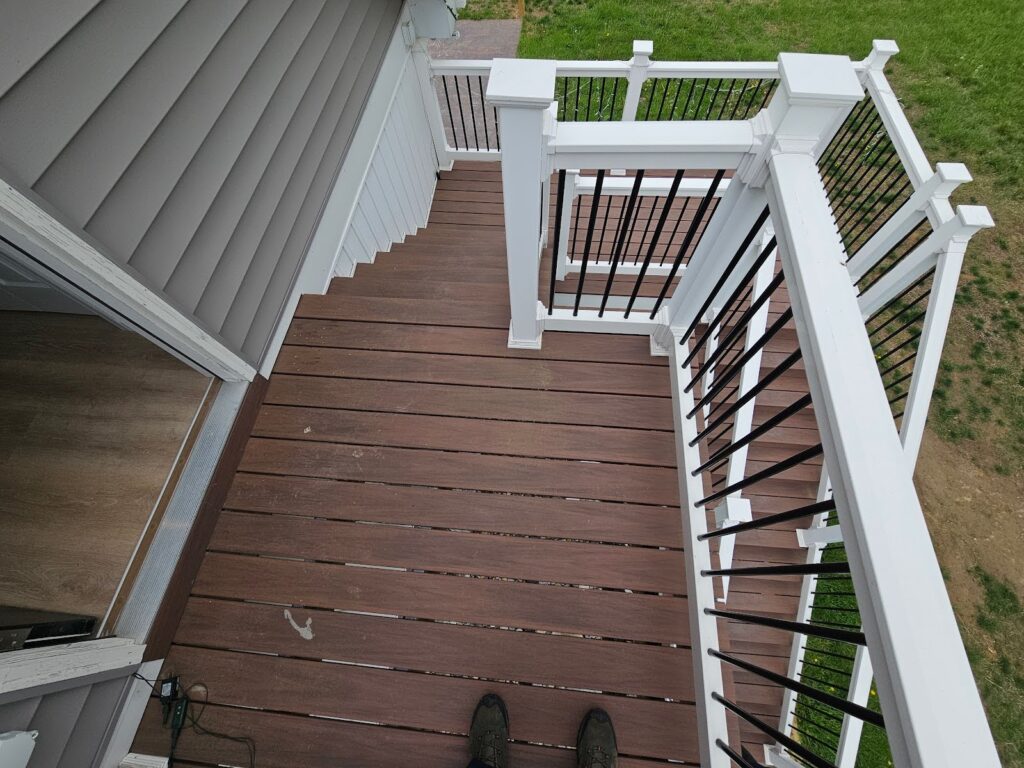
The extra ample space is much appreciated because it makes the stairway much more ergonomic. The particular pathway shape of the stairway is often referred to as a U-shaped stairway. Some people also happen to call it a switchback stairway. Other types of stairway configurations are also common. One of them is a straight path stairway. Generally even if it’s a stairway that has a straight path, a midlanding will be required after or at a total rise greater than 12 feet and 7 inches. Regardless of the total height that you still need a landing at the top and bottom of the stairs.
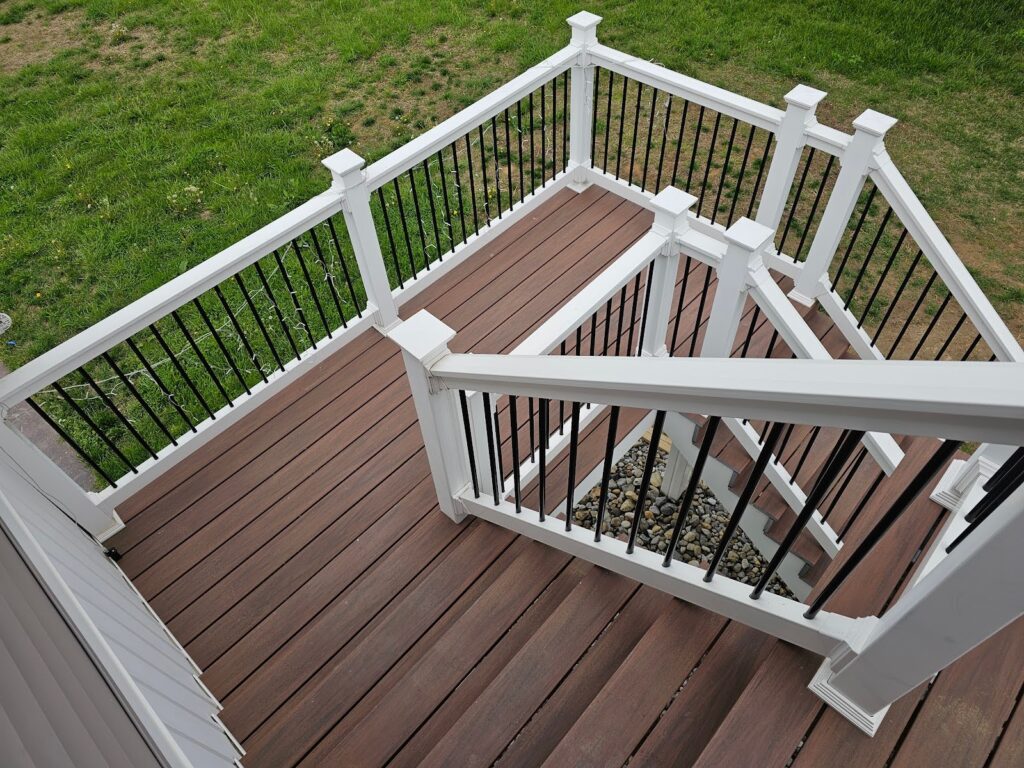
The total vertical rise allowance before a mid landing is required is an interesting specificity. They’ve selected this constraint because it’s intended to be able to accommodate the elevation of most first floor entrances. Really tall first floor levels though would require a midlanding. They require a midlanding in total elevation rises greater than this dimension because people have a tendency to get tired while walking upwards. The midlanding gives them a spot to pause and rest for a moment.
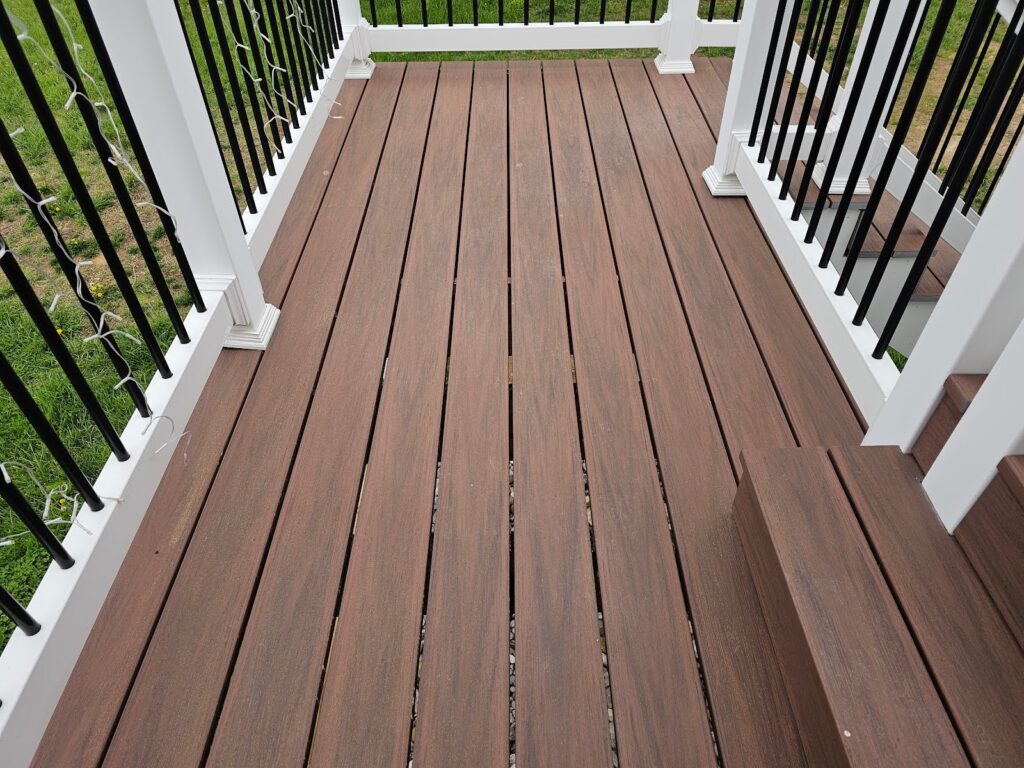
As a side note about the bottom landing, it can be a patio type area, but it cannot be loose materials like loose dirt or gravel. It makes sense because people need to be able to get proper footing. As well, the slope of that area is not allowed to be more than roughly 1/4 of an inch per linear foot. That’s a roughly 2% grade. That’s enough grade to allow water to flow properly, but not so much slope or grade that will cause a trip or slip hazard.
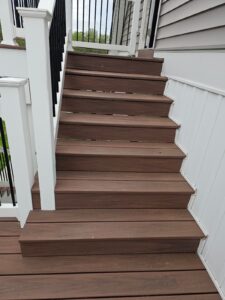
The deck landings are very ample, and the staircases themselves are also sufficient for use to access a building from the exterior. One of the interesting details of this particular staircase is that instead of a typical three stringer type of arrangement to support the stair treads, they’ve used a four-stringer configuration. That type of configuration provides a much better supporting strength.
Use a contractor who understands and cares about doing things right. Always, feel free to reach out to us here at Dupont Decks and Patios. We are happy to help with almost all steps of the deck building and design process. A backyard and outdoor space should make a significant, positive impact on both quality of life and home value. We can help with more than just decks, we also build patios, pergolas, ramadas, awnings, gazebos, arbors, and privacy fences.
Let us know about your ideas and talk to us if you have questions about possibilities. We are happy to participate in improving your outdoor space and quality of life! You can call us at (202) 774-9128. You can find us online at https://dupontdeckspatiosdc.com/ and you can email us there as well at https://dupontdeckspatiosdc.com/contact-us