Building a Stairway Using Deck Construction Method
This past week, we took a look at a lot of the details related to the space requirements and configuration requirements of this particular stairway. We also talked about the similarities of the materials and methodologies of the framing used to create this stairway and a typical deck. This particular stairway happens to be very similar to a deck construction, even though it’s just intended to be used as a stairway. Because of the ample space allocated for this stairway, it makes it much more comfortable to use for a pathway.
One side note that we didn’t mention this past week is that the extra space by an entryway is particularly useful because you can use it to put a little side table. Even if it’s not enough space for seating or chairs, just having a tiny table next to the entry door can be very useful. Not everybody has to do this and clearly not everybody does. Personally though, we like the side table by an entrance because it gives somebody a place to rest a single item such as a grocery bag while they pull out their keys. We find it helpful.
Some spaces are just tight though. Some deck configurations don’t have enough excess room available to allocate for even a small additional space like this. After spending so much of our lives working here in the tight physical restraints of Washington DC, we happen to really appreciate any extra little bit of space available.
Last week, we also mentioned that the decking flooring materials are different from the deck framing materials, in this case. The decking materials are the upper surface that you walk on. The framing materials are the wooden substrate framing that supports the walking area. That structural support framing is made from pressure treated southern yellow pine. That’s an almost entirely natural material grown largely here in the United States.
The wood, after a milling process, is submerged in a pressurized tank of chemicals. The pressurization makes the liquid chemical application infiltrate into the grain of the wood. That wood preserving solution includes chemicals that help prevent aging, deterioration, and rotting. When many of the domestic and or even Canadian wood materials are exposed to moisture, after being harvested and milled, they can age and deteriorate quickly. Particularly, without treatment, the wood will be relatively quickly eaten by termites, in most cases, here in the USA.
The makeup of the decking itself is very different than the pressure treated southern yellow pine substrate framing. The decking here is made up of a combination of plastics and recycled wood products. One of the manufacturers mentions that no trees need to be cut down to make these deck boards. All of the wood materials and a significant portion of the plastic materials can be recycled. You may notice that even though the guardrails are a white color, the balusters in between the post of the guardrail are a black metal type material. This particular material is aluminum.
Aluminum, in some cases, might be a little bit more expensive than steel. Here though the aluminum has the advantage of not needing upkeep and maintenance for the majority of the life of the deck. So, like many things in construction, here there is a trade-off between cost and maintenance requirements.
You can consider the maintenance requirements a cost, as well as the cost of purchasing the materials. Together, to compare these items, you might refer to the purchase cost as the first cost and you might refer to the upkeep cost as a life cycle cost. In many cases, in construction, it may be worth spending more on the initial cost to reduce the life cycle cost of a material.
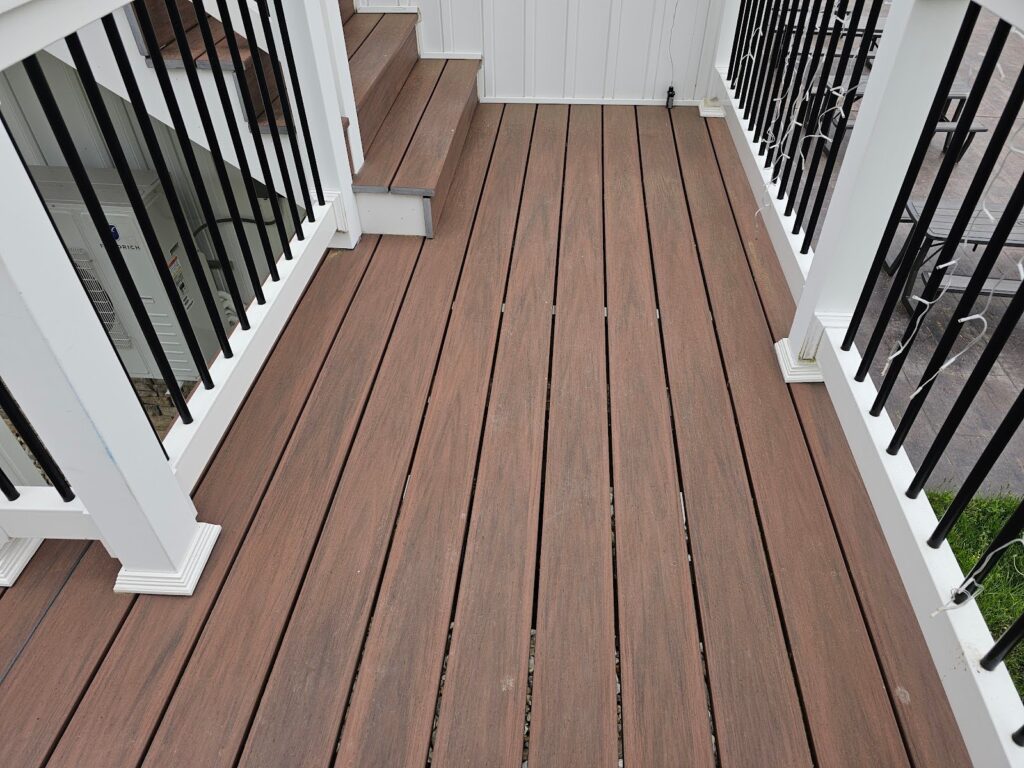
The next picture below shows a different deck that also uses a similar type of composite wood decking. The color here also happens to be brown. There are many other color options available though. Some of these color options range from blues to grays.
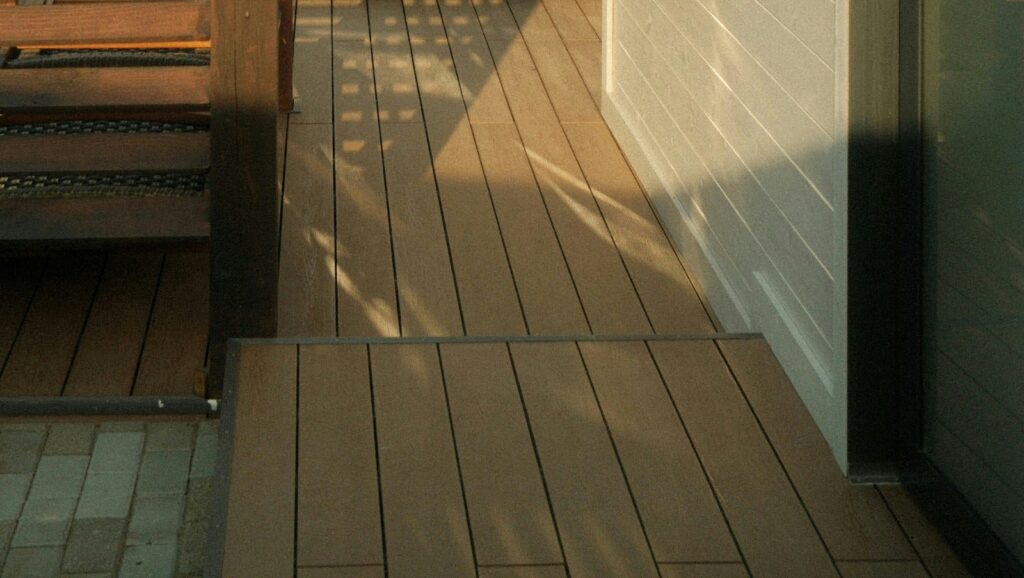
A final example of a composite type wood decking is shown in the next picture below. This happens to be a lighter color, but also in the same family of brown. Here, instead of using a synthetic or composite type handrail, they have built a handrail with natural wood. The cap on top of the handrail though is a composite material.
This is not just coincidence, it’s a purposeful decision. Water, such as precipitation, that lands on top of the post will enter into the end grain of the wood. The end grain is particularly sensitive because it’s one of the areas that receives the least amount of treatment, in the center of the wood. End grain also has a tendency to allow rainwater to enter more rapidly. The end of the grain is like a stack of straws, to some extent. To a degree, those cellular grains will allow water to enter and enter more freely because of the capillary action of the cellular structure.

Use a contractor who understands and cares about doing things right. Always, feel free to reach out to us here at Dupont Decks and Patios. We are happy to help with almost all steps of the deck building and design process. A backyard and outdoor space should make a significant, positive impact on both quality of life and home value. We can help with more than just decks, we also build patios, pergolas, ramadas, awnings, gazebos, arbors, and privacy fences.
Let us know about your ideas and talk to us if you have questions about possibilities. We are happy to participate in improving your outdoor space and quality of life! You can call us at (202) 774-9128. You can find us online at https://dupontdeckspatiosdc.com and you can email us there as well at https://dupontdeckspatiosdc.com/contact-us