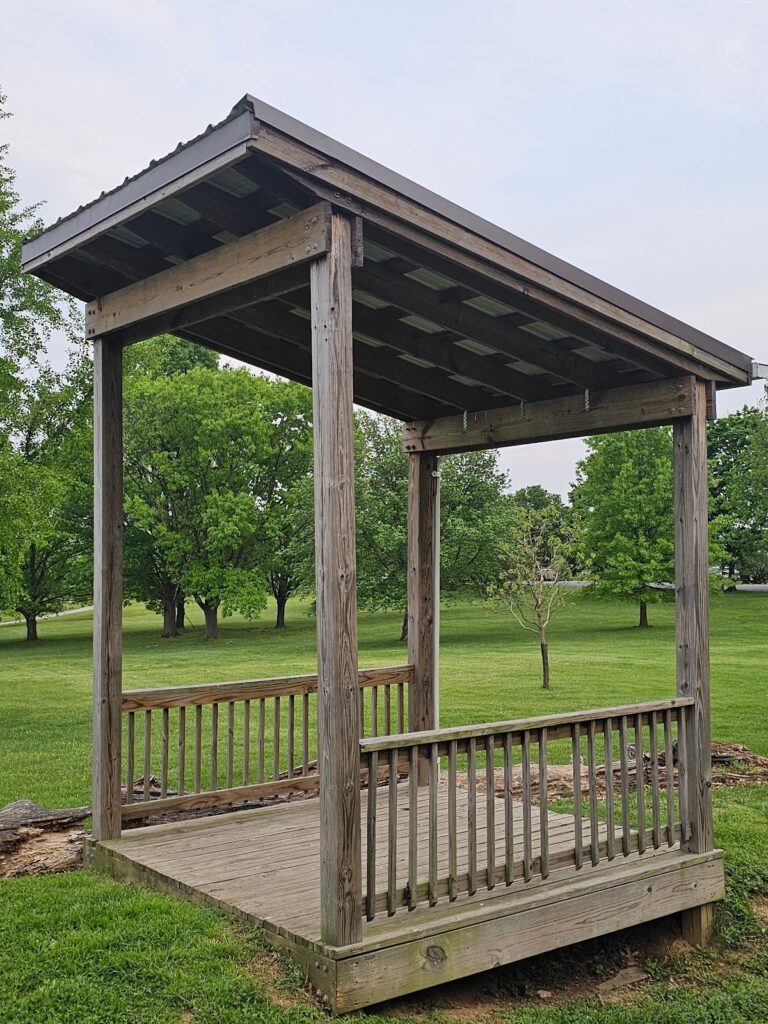
A Simple Gazebo Deck with Roof
The deck we’re looking at today really isn’t in a backyard. It’s part of an actual park outside of the city. It also isn’t actually a gazebo. It’s really like a simple type of shelter, but it isn’t the kind of shelter we think of as a place you would stay of course. It’s actually like a little teeny miniature pavilion, we just think of a pavilion as being much grander.
It spans over top of a swale or a ditch in the ground. Most of that depressed area of the swale is covered in grass, but you can see the contour dipped down below the deck. Here, in the shadow line of this deck like structure, the grass doesn’t grow, there’s just brown dirt. It’s kind of a little bit like a covered bridge. You could walk across it from one side to the other and stay underneath the cover. Except it’s nothing like the famous old covered bridges we think of in the sleepy towns of the Appalachian mountains and places like that.
It could be like a little mini bridge over a ditch on a walking patch. Except here as well, it doesn’t fit that description perfectly either. There’s no real beaten path that goes to and from this deck. Instead, just sitting in the middle of the park. You could think of it like a gazebo, more than it is like an actual typical deck. In most cases, decks are attached to or close to main buildings. They don’t have to be though. But that can be out in the middle of a yard or a field somewhere too and still serve the same or similar purpose.
From a carpentry and materials type perspective, this particular construction is very similar to a typical deck though. This just happens to be covered with a little roof. Of course, many decks have no covering at all and this one doesn’t need it, they just added it. It’s definitely a useful feature, particularly when you want to spend some time outdoors even when it’s raining out.
It’s great to have at least one part of outdoor covered space in a home. You might have an area to enjoy the outdoors in both the front yard and the backyard, but at least if one portion of one of those areas has a cover, it makes it very nice for those rainy occasions.
In the next picture below, you can see the area that we’re referring to. The ground underneath of this deck is not in level with the adjacent ground. But because the deck is there, it doesn’t have to be level. The deck is working like a little bit of a tiny bridge to span that area. It wouldn’t be terrible to have a trail that goes across an area that has a deep divot like this, but the bridge gives an alternative.
In the picture below, you can see on the right hand side, below the floor frame of the deck, there is a post that sticks out, going downward into the ground. This post is helping keep the two sides level. Essentially, without it, the deck wouldn’t be sitting as high on that right side as it is left. The left side may also have a set of posts, but here they’re concealed. As well, the relationship between the surface of the ground and the deck is different. The left hand side is just above the grade level.
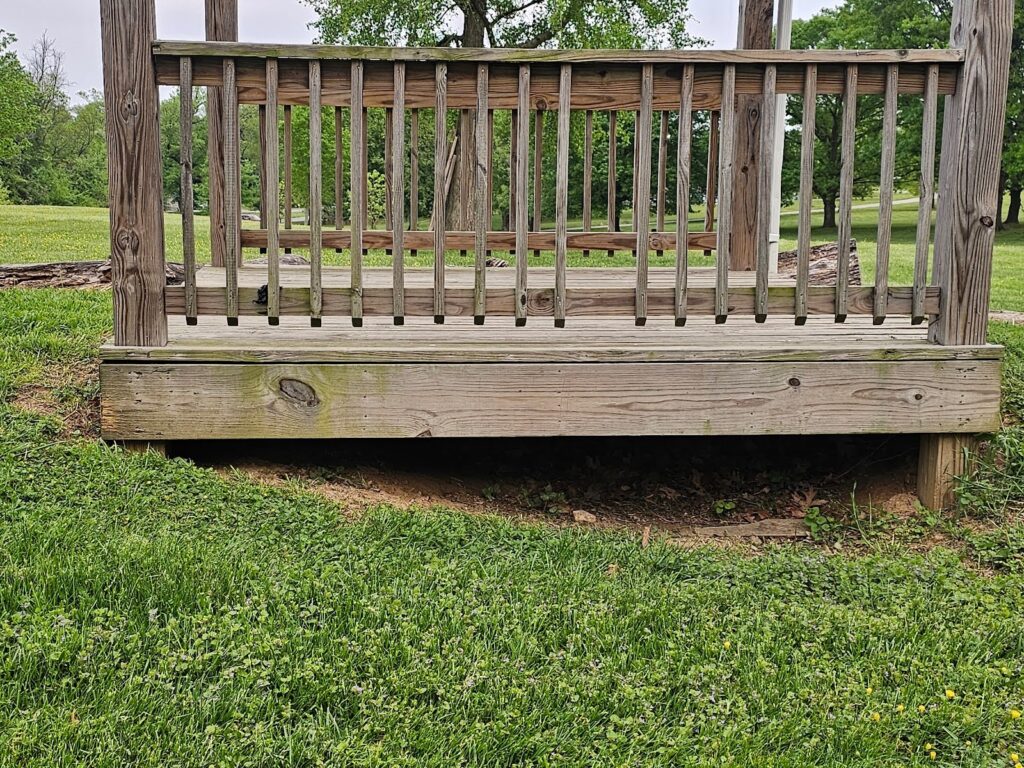
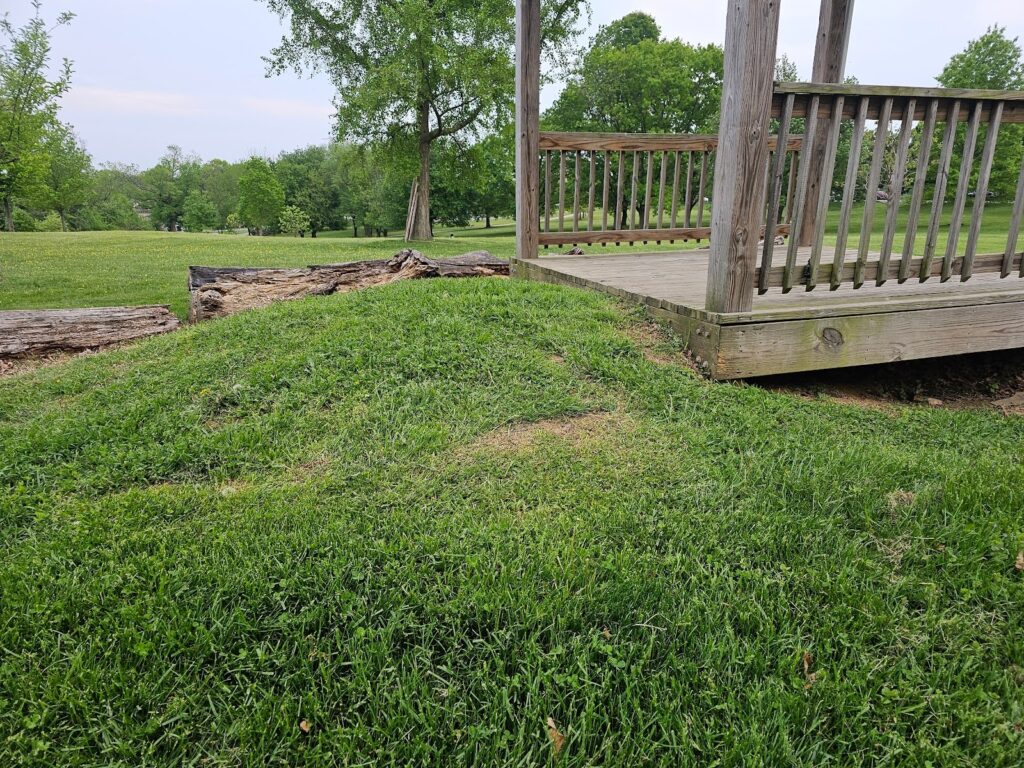
The next picture below shows a view, looking down into the deck from the walking path type direction. Here you can see that the deck sits almost level to the adjacent ground, it’s like at this edge of the pathway, the deck is suppressed. But it’s perfect, from a path perspective. If it were sitting way above then it would be a necessary or differential type of step up. You may notice that there is a sort of roundedness to the area that meets up against the edge of the deck.
It’s like the soil was added there and or has rounded sides so that it’s almost like a rounded mound. Because of the shape of this area of the dirt or ground, it makes it so that walking off the corners or edges of the deck at the corners is less level or stable. Instead of just adding the extra dirt there, if they also added two small retaining walls, one on each side to the edges of the deck, it would help keep the pathway perfectly in line with the edge of the deck, in most cases.
In this coming week, we’re going to talk about the materials used to build the deck itself and also the roof covering above the deck.
Use a contractor who understands and cares about doing things right. Always, feel free to reach out to us here at Dupont Decks and Patios. We are happy to help with almost all steps of the deck building and design process. A backyard and outdoor space should make a significant, positive impact on both quality of life and home value. We can help with more than just decks, we also build patios, pergolas, ramadas, awnings, gazebos, arbors, and privacy fences.
Let us know about your ideas and talk to us if you have questions about possibilities. We are happy to participate in improving your outdoor space and quality of life! You can call us at (202) 774-9128. You can find us online at https://dupontdeckspatiosdc.com and you can email us there as well at https://dupontdeckspatiosdc.com/contact-us