Offset Deck Loadpath Issues: Repair & Reinforcement
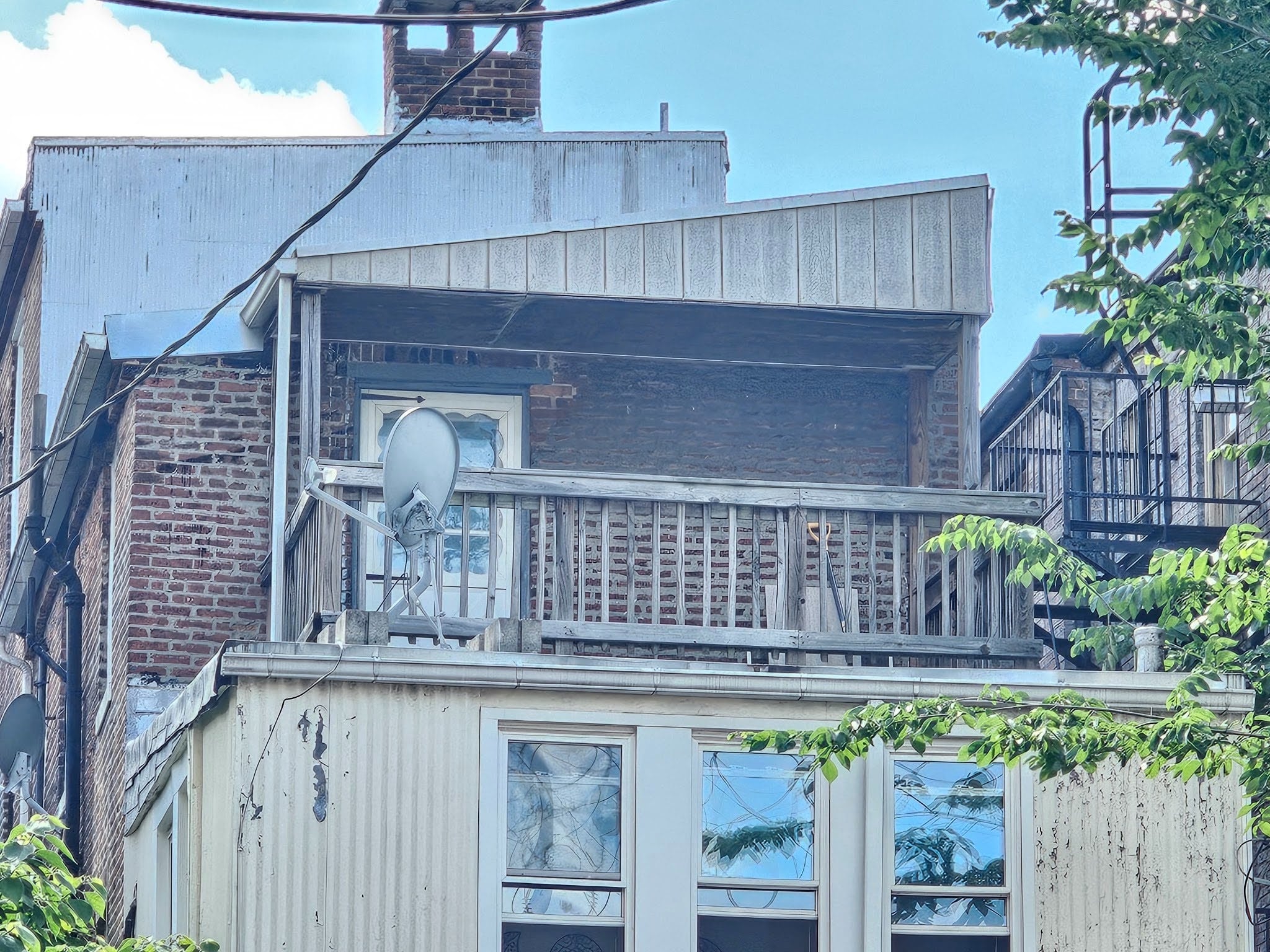
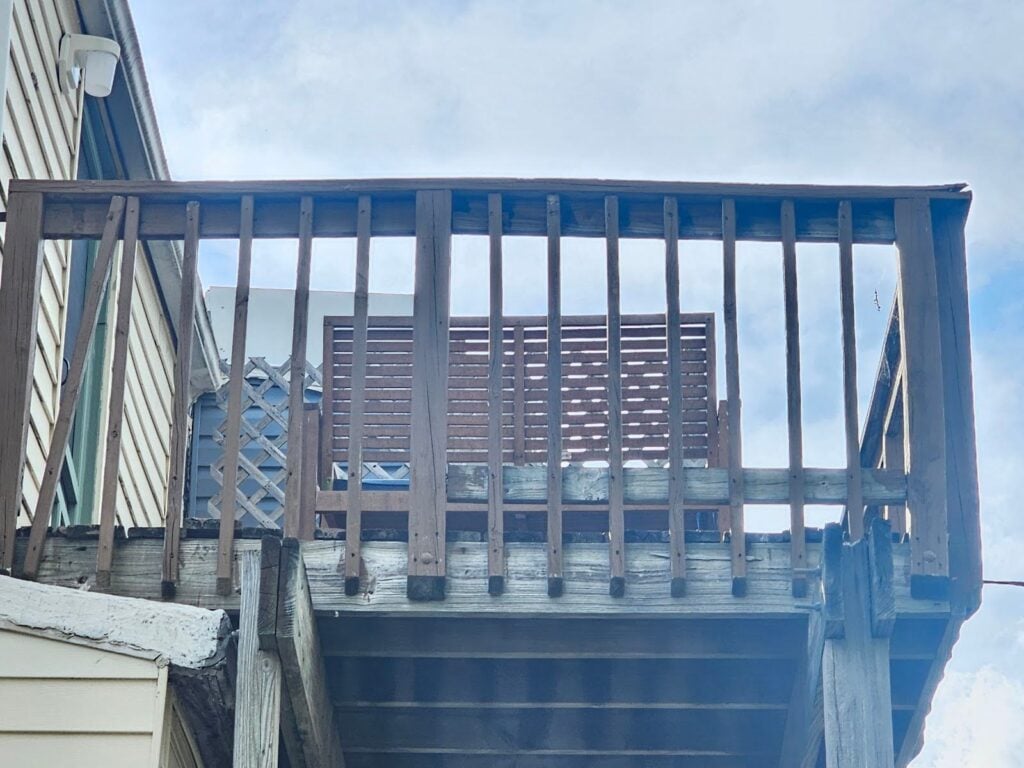
This past week we looked at a rear yard elevated deck with an offset in the load path. That offset happened to be between the vertical post in the edge of the effective deck walking surface. The guardrail essentially was roughly 18 inches set inward from the post at the side of the deck. You can see the edge of this deck from a view at the side of the building looking upwards, in the picture below.
We discussed the topic of vertical load resistance. Essentially, these posts are used to keep the deck suspended up in the air without sagging or deformation which would otherwise cause the deck to lower and or structurally fail over time or through natural movements.
In this week’s article, we’re going to look at some of the additional details that we didn’t get into too deeply in last week’s discussion. We mentioned the intermediary supports at the vertical post and we’ll take a look at the girder assembly. We will take a look at how the guardrail posts are mounted to the rim joist of the deck. We’ll also look closer at the omitted ledger board.
In other decks that we’ve looked at in the past, particularly where they’re built tall, we’ve seen some cases of 2x dimensional lumber used between the vertical posts in a crisscrossing type of fashion to provide support and stability to the post. Tall post like this without intermediary framing elements can have a tendency to move around significantly. Shifting and moving, in times of instability or high winds can lead to failure and even collapse of a deck. Here, They installed a simple horizontal board between the post. This does help a lot but it’s not nearly as strong as a crisscrossing angled or diagonal cross bracing.
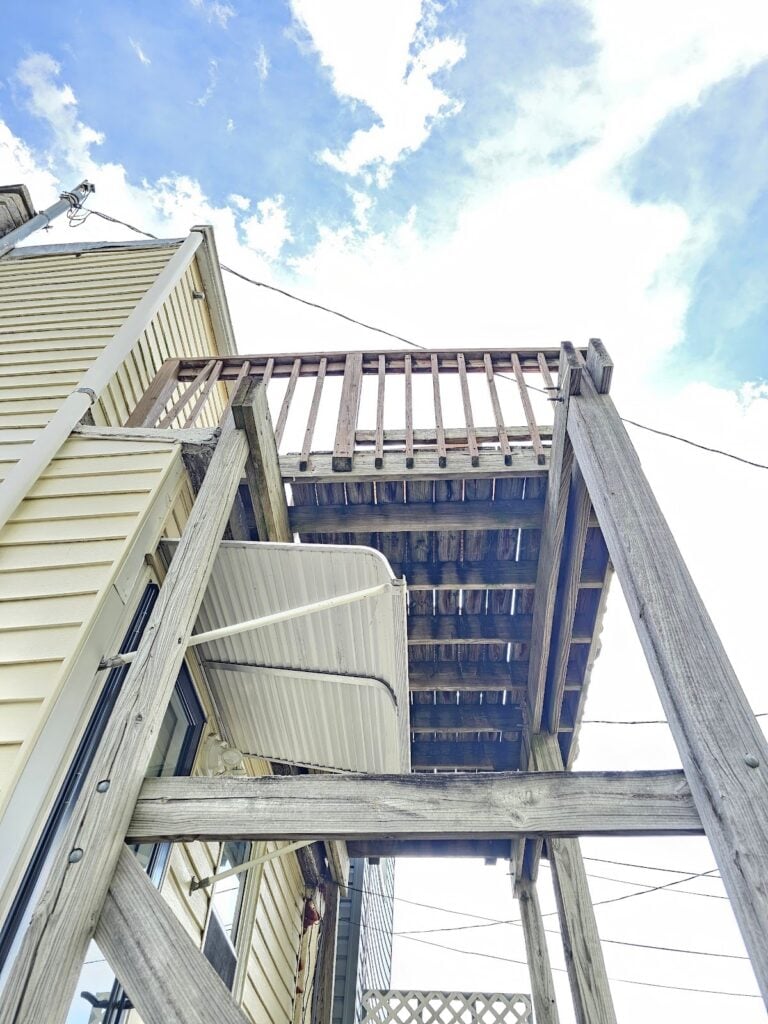
We’ll start by talking about the overall height of this deck. Unlike most typical basic decks, this particular deck happens to be a double story deck. There’s a lower ground level deck and and an upper deck. We’re looking most closely at the upper level deck which comes off the rear bedroom at the top floor of the house. Even in the case of a typical ground level deck, sometimes there’s also a little bit of extra height because there’s an underlying basement.
Even when a basement is mostly underground, there’s generally a little bit of space at the top of the basement walls where those walls come out of the ground. This means that even deck that is close to ground level is generally built up a bit. In a case with a basement that comes above the ground at the rear of the building, it just might require a handful of steps to get up to the level of the deck.
It helps to build a basement with a bit of elevation above grade, in relation to top of the basement wall. That extra height can have windows installed to allow some lighter or fenestration to enter from the natural daylight into an otherwise dark and dimly lit basement. It also helps to have the top of the basement wall a bit above the adjacent grade were the level of the dirt outside of the house. By having the basement come up at least a foot or two, It allows for mounting location between the transition from concrete or masonry to a stick frame building. In historic parts of Washington DC, most houses were not built with stick framing.
Instead they were generally built with an entire brick wall above grade. in some cases, they even use bricks below grade but the brick would start out as a triple withe instead of a double withe which was used for most of the walls above grade. It helps for that transition to happen above the ground level though. That can reduce a lot of the moisture that can cause problems both for thinner brick walls and for stick frame buildings..
It’s different than an elevation at the transition between the top of the foundation and the first level of the house. It is important because it generally requires at least a small stairway or set of steps up to what would otherwise be considered a ground level deck. In this particular case, the top floor deck is not only built an entire level above grade, but there’s also an additional 6 ft between the ground level deck and the actual ground. When you combine these elements together it makes for a really tall deck.
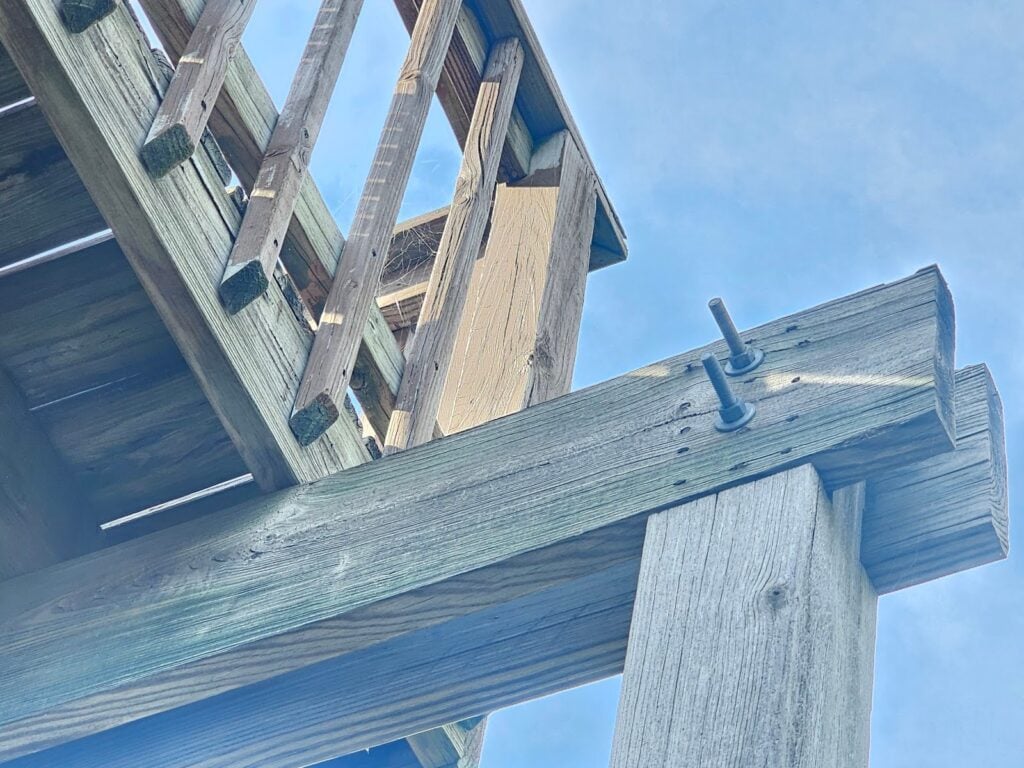
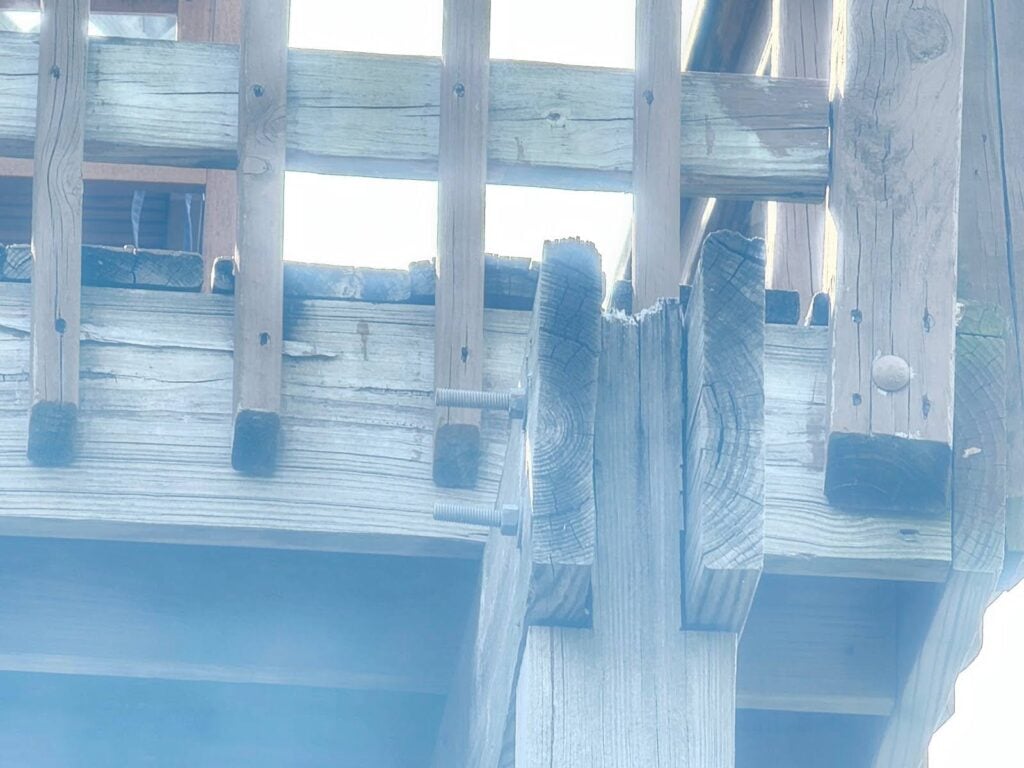
We also talked about the bolting of the guard rail. In the picture below you can see how that outside guard rail post is bolted through the bottom of the post into the rim joist.
This next picture shows that bolt location even closer. In addition to the bolting, a pattern of four fasteners was also installed at the corner above and below and to the left and right of that particular carriage bolt.
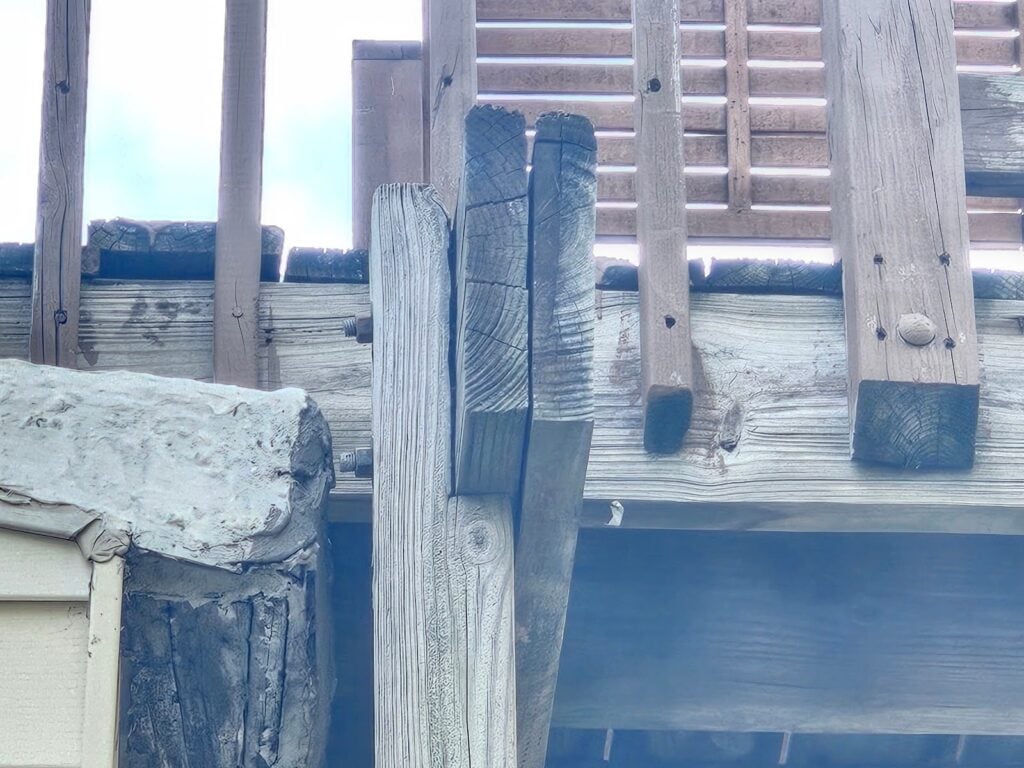
You can also see the top of the post, where the girder is mounted and connected in another picture above, at a greater angle. this particular picture below shows you more in profile, at the side of the deck. This particular post is a 6×6 timber. It’s essentially pressure treated Southern yellow pine that is milled and cut to finish at about 4.5 in wide x 4.5 inches deep.
They’ve cut a 1.5 inch notch in each side of the post. That notch allows for shouldering and nestling of the 1.5 inch x 12 inch girder atop the pair of 2x girders. Together this type of sandwich connection, particularly where bolted and shouldered through, is generally considered to be pretty strong.
The only main variance or concern is over the entirety of the span. Additional posting down may be required depending on the distance of the total span.
Here, you can see the post closest to the rear wall of the building. This particular post is built with a girder at the top, just like the post at the outer rearmost edge of the deck. Ledgers are more significant than girders because they have a more stable substructure which they’re mounted to, the house itself. Ledger boards are simply much complicated though because they require removal of at least a portion of the rear siding and flashing both on top of the building wrap and building siding, in the case of stick framed construction.
Use a contractor who understands and cares about doing things right. Always, feel free to reach out to us here at Dupont Decks and Patios. We are happy to help with almost all steps of the deck building and design process. A backyard and outdoor space should make a significant, positive impact on both quality of life and home value. We can help with more than just decks, we also build patios, pergolas, ramadas, awnings, gazebos, arbors, and privacy fences.
Let us know about your ideas and talk to us if you have questions about possibilities. We are happy to participate in improving your outdoor space and quality of life! You can call us at (202) 774-9128. You can find us online here at contact us page and you can email us there as well.