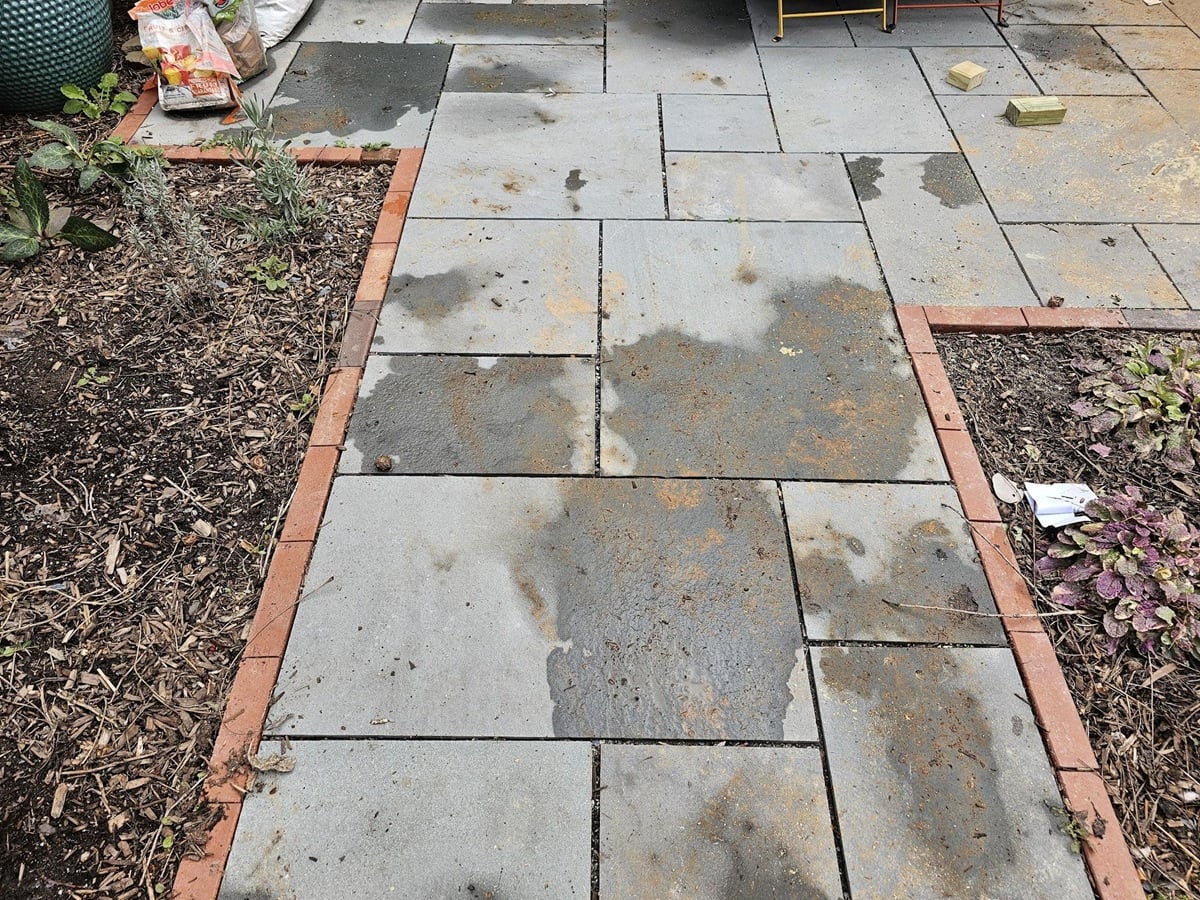
This past week we started taking a look at it a couple different areas of brick walkways with raised edging at the sides of the walkways. This raised edging helps in several ways. It sets a limit or boundary to the adjacent garden. You can see, in the picture below, there is a bed of deep mulch in the garden around the shrubbery and landscaping. The raised edging helps keep a lot of that mulch from getting blown into or washed into the area on top of the brick walkway. The walkway itself is made from a different type of brick than the edging.
The edging is built with a cementitious mortar between the individual bricks. The walkway itself is set onto a bed of sand without being built with a cement bed which locks each paver brick into place. Since the edging is set at the perimeter, those bricks are bounded and held in a relatively locked position by the edging alone. In this particular case, at the horizontal area of the walkway, having the freedom to allow for micro movements actually helps preserve the brickwork from breakage at places of shifting in the subsoils.
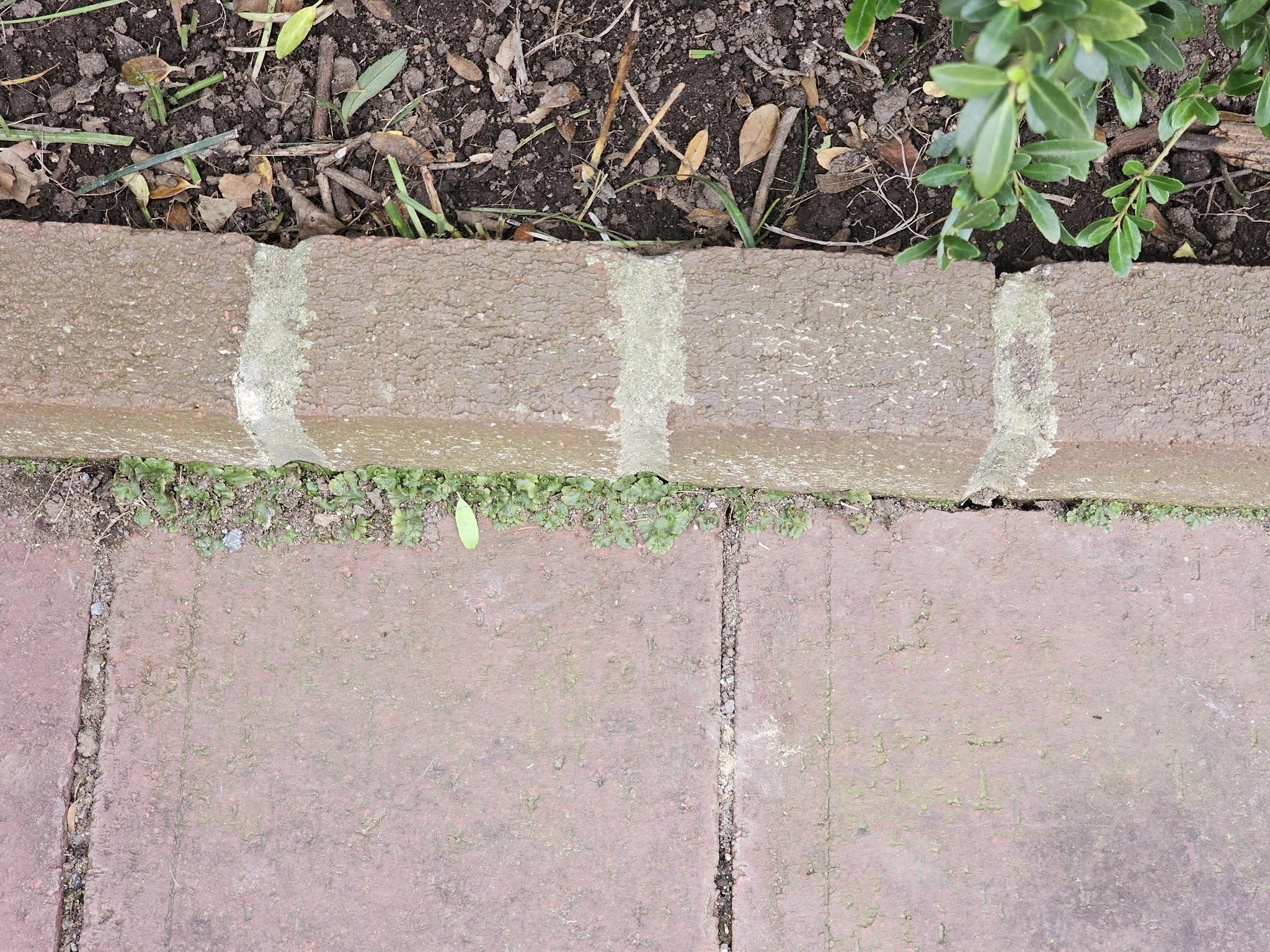
Since the brickwork at the horizontal area is not mortared into place, you can see there is some biocolonization, small elements of plant growth that are springing up at the inside corner between the horizontal paving brick and the vertical edging. That location, not just here but in most types of similar walkways, would be one of the first places where you might expect to see plant growth first take root. It’s an ideal location for plant growth because it is one of the few areas of the horizontal walkway that’s kind of protected from foot traffic.
There is nothing really stopping somebody from putting their toe or edge of their foot into that area of the inside corner, but people don’t normally walk with their feet poking right into the tight edge of the corner. In fact it is a little bit difficult to get a big part of your shoe so tight down into that corner. Therefore, just by the geometry of the shape between the horizontal surface of the brick and the vertical edging, it’s a bit difficult for the inside corner of the brick to be in contact with much of the typical pedestrian walking. Therefore, although we can still see the area very clearly, it’s somewhat protected.
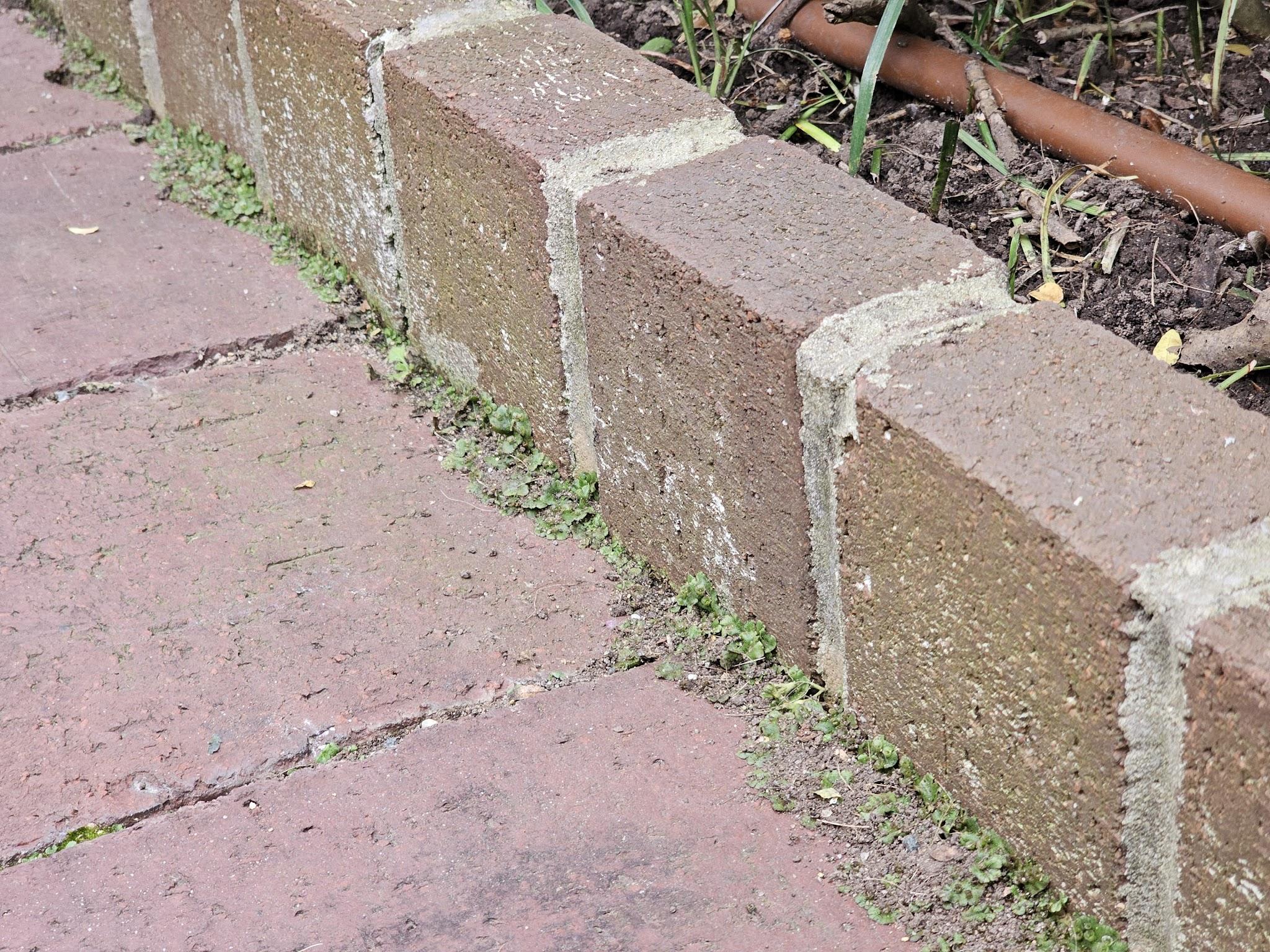
When you think of a round wheel, the same issue or type of protection to the plants in the corner occurs inadvertently. It’s not intentional, nobody really wanted to protect invasive little plants from growing in that corner area, but inadvertently the edging has that effect. For example, if you were in a wheelchair, or pushing a stroller, it’s very hard to get the wheel into that tight corner. The wheel has to be perfectly aligned with the longitudinal direction of the edging and then ride all the way tight to the corner.
If the wheel makes contact with the edging from any other angle, the square shape of the corner will not receive the entirety of the wheel. Instead it’ll stop short of the edge or inside a tight corner of the edging. One of the several advantages of the edging is that it will guide wheels of things like wheelchairs and strollers. Those wheeled devices are sort of kept in line on the walkway by the edging itself.
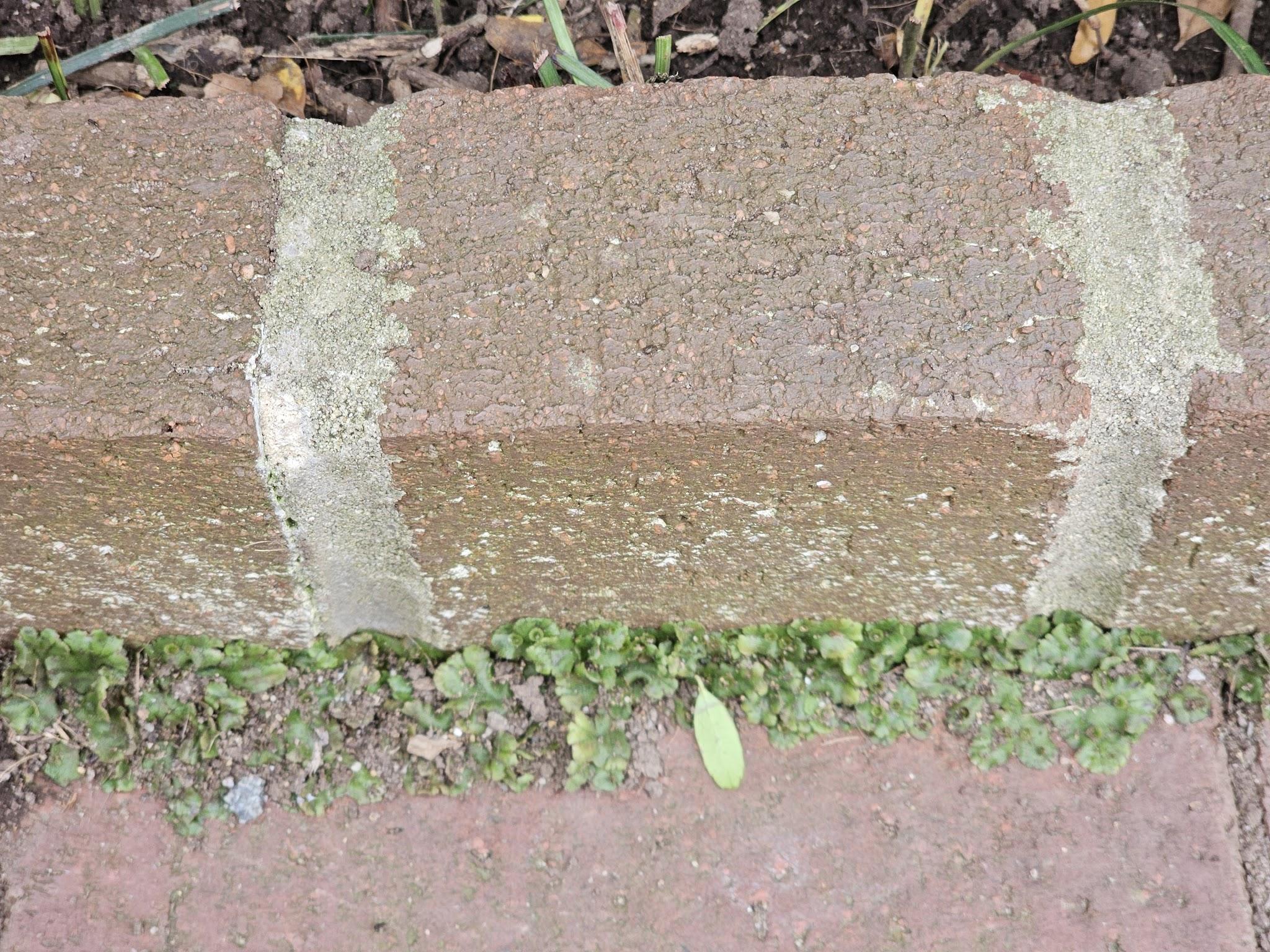
Another one of the advantages of the raised edging is that it creates a distinct visual boundary between the parts of the landscaped space. It’s a bit like a clean defining boundary. That demarcation makes the spaces and their design feel intentional. That definition and separation not only inadvertently protects the unwanted plants such as these weeds and small ones in the corner, but it also protects the larger plants that are intended to be growing on the elevated adjacent sides of the walkway.
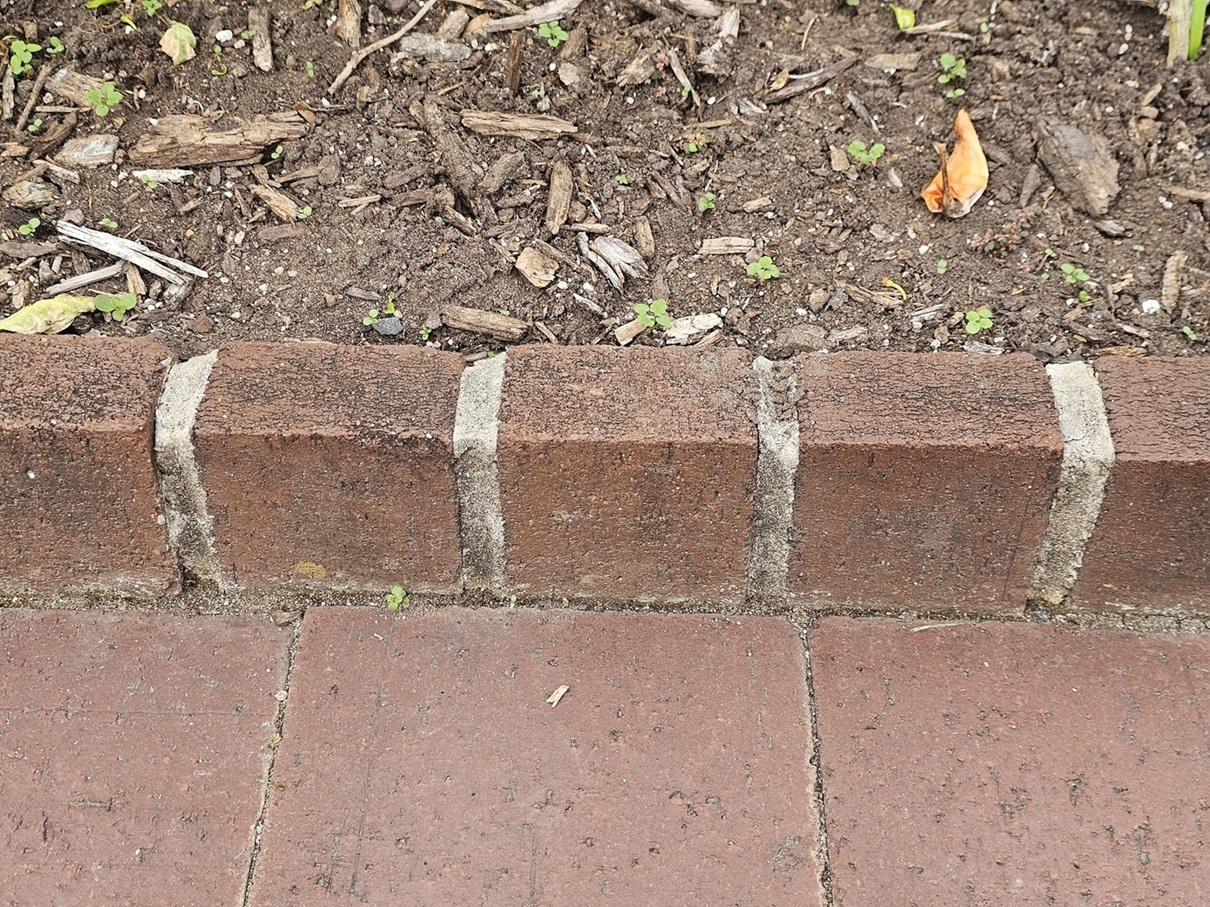
In this coming week, we will take a look at a visual border built with brick at a stone walkway. the edging is similar in some ways, except it is not raised. That edging is just for aesthetic purposes and set down into the same plane as the field masonry of the walking pathway.
We recommend building and homeowners here in Washington DC use a contractor, like us, who understands and cares about quality, deck and patio longevity, and simply doing things right. Always, feel free to reach out to us here at Dupont Decks and Patios, you can give us a can or just drop us a line.
We are happy to help with almost all steps of the deck and patio building and design process. Let us know about your ideas and talk to us if you have questions about possibilities.
You can call us at (202) 774-9128. You can find us online and you can email us there as well at https://dupontdeckspatiosdc.com/contact-us/