Custom Bench Seating Around a Patio Planter Box
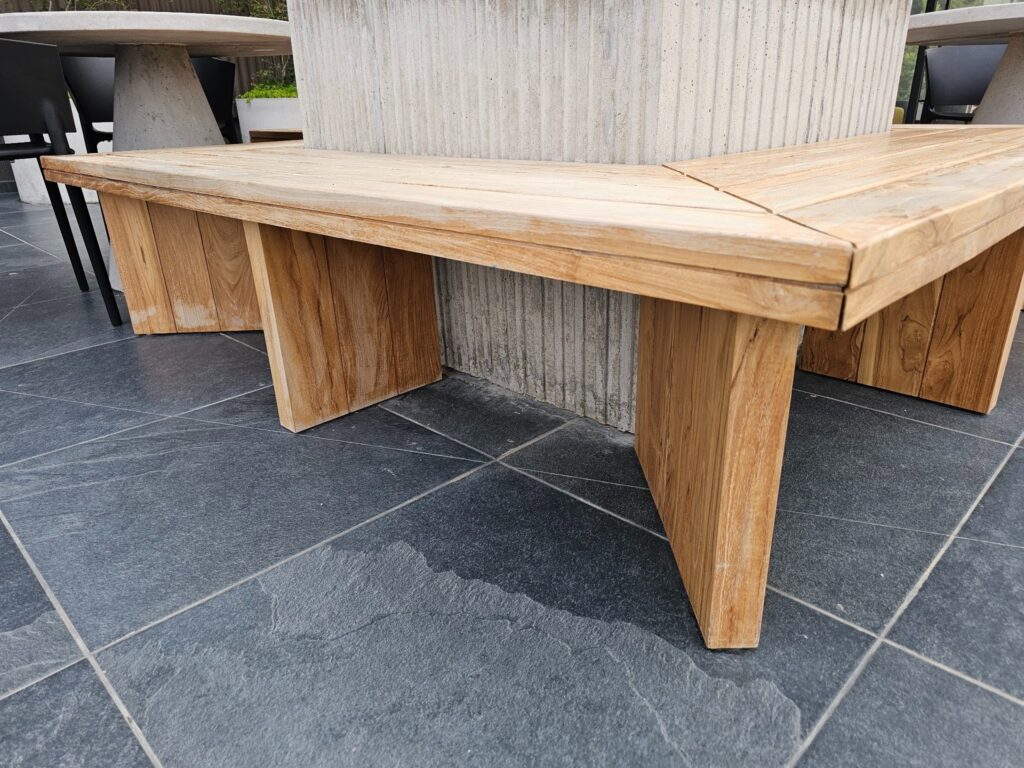
This week we are looking at a relatively simple but still creative bench built on four sides around a square planter box. The planter box is shown in the picture below with the bench seat built around it. To start, the planter box is interesting because it’s very large. It’s likely put together with a relatively lightweight growing medium.
There is a small sapling size tree in the center of the planter. For most trees to grow well in a planter, they need to be a good bit of actual heavy soil. In this case they may have interspersed the nutrient laden soil with a lightweight medium to balance or reduce the hydrostatic pressure better. The planter itself has relatively thin walls. When concrete is built in thin applications or thin sheets, it has a tendency to fail at an accelerated rate.
Generally steel is used as a reinforcement in concrete but that steel has to be enshrouded with at least an inch or more of concrete around it. In this case the concrete walls of the planter aren’t even that thick so the total amount of encasing concrete is less than half of the minimum recommended amount. To a large extent, this particular concrete may also be significantly reinforced with fiberglass strands. Some of the manufacturing of dry concrete pre-mixes use fiberglass reinforcement. In most cases though, outside of high margin pre-mixes, fiberglass is used more in commercial applications.
Our company will often procure fiberglass in large quantities and then apply it in mixed batches for our deck and fence post footings. The fiberglass can allow concrete to be built a bit thinner without the same level of failure related to insufficient tensile strength resistance. Hydrostatic pressure is essentially the buildup of moisture in a soil. When soil is particularly hydrostatically charged, it puts more pressure on the outer walls of something like this planter box. In this particular case, the planter box also has a drain at the bottom that allows water to move freely through. That helps reduce the risk of accelerated breakage or failure from hydrostatic pressure build up.
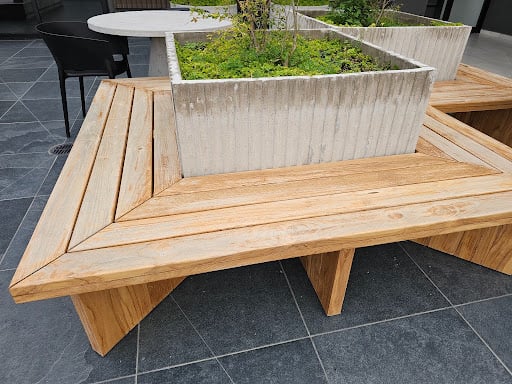
This bench is built with an interesting type of wood. It’s a natural wood just like the common pressure treated southern yellow pine used so prolifically here on backyard decks or benches in Washington DC row homes. This wood is very different though. Even though it has a light almost yellow beige color, it’s actually made with a exotic hardwood called teak, aka tectonic grandis.
Teak is generally multiples more expensive than the more common pressure treated Southern yellow pine. It also performs differently. If you notice, in the picture below, miter joints have been used at the corners of the bench. We also will use miter joints with treated southern yellow pine, from time to time, but in time when sealers wear out, pressure treated southern yellow pine mitre joints can shift and change. Pressure treated southern yellow pine has a tendency to warp and twist more than teak wood.
Teak is naturally highly resistant to moisture. Pine woods will generally rot much faster than many other types of wood. The pressure treating helps preserve pine, but without it it can’t withstand exterior exposure.
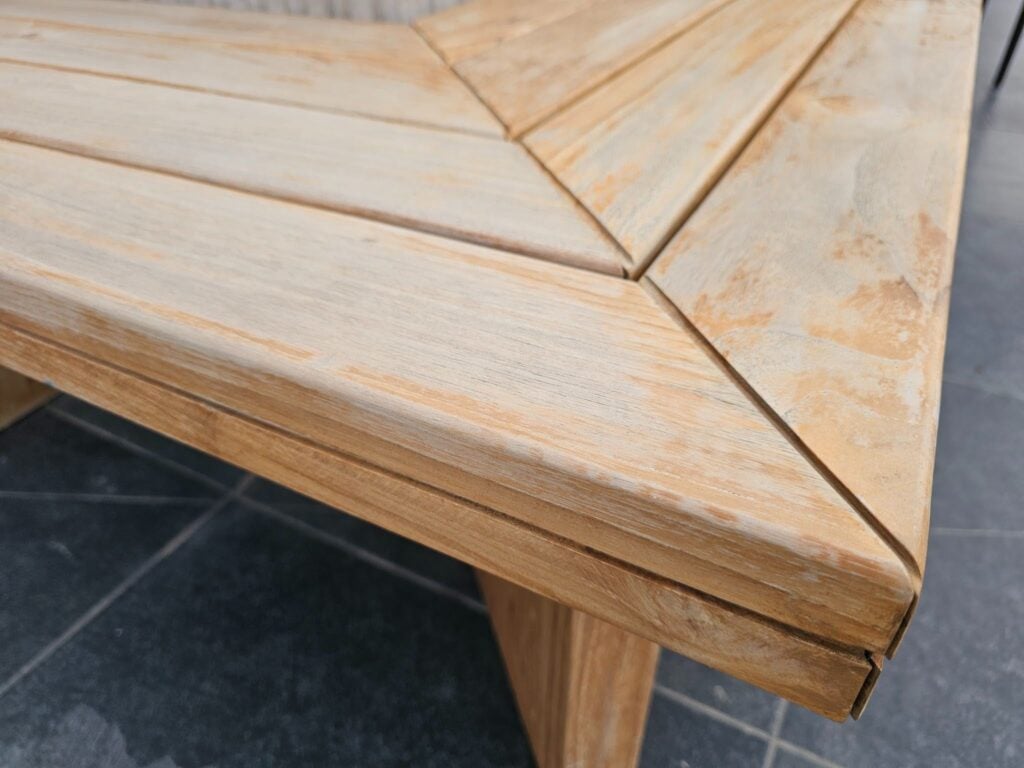
In the next picture below, you can see the outside corner miter joint more closely. Three 6-inch boards have been used in the construction of this bench. Each of those boards has been doubled and joined to an additional board below. None of the hardware is apparent at the upper surface of the bench boards. As you look closely, you may notice there are spots throughout the boards where the surface has faded.
Even though teak wood is naturally highly resistant to exterior exposure, it’s stain and sealer will still deteriorate. Generally, stains with large proportions of pigments will help preserve the substrate wood from accelerated ultraviolet deterioration. Ultraviolet is found in everyday natural sunlight, but it will destroy most types of wood, over time. Even teak is susceptible.
Like many types of exterior deck and bench type construction, with natural wood, a 2x dimensional lumber has been used in the building of this bench as well. Often balusters or pickets at guard rails and handrails will be built with 1.25 inch pickets, but otherwise 2x dimensional lumber is more common.
We recommend building and homeowners here in Washington DC use a contractor, like us, who understands and cares about quality, deck and patio longevity, and simply doing things right. Always, feel free to reach out to us here at Dupont Decks and Patios, you can give us a can or just drop us a line. We are happy to help with almost all steps of the deck and patio building and design process. Let us know about your ideas and talk to us if you have questions about possibilities.
For questions about your deck or patio project, call us at (202) 774-9128 or visit https://dupontdeckspatiosdc.com to learn more about our services and get in touch with our team.