Decks Built on Steel Bases – Part I
Here on our blog and website, we’ve looked at a great many different backyard decks and even front yard type decks and porches. They’re very common here in Washington DC. They’re built from a variety of different types of material. In many cases, front porches will be built with a mixture of brick masonry and wood framing. Historic wood deck framing was a little bit different than a typical stick framing used to build track homes out in the sprawling suburbs, but the floor system of a deck, both for a typical backyard deck and even a historic front porch will often be built with 2x dimensional lumber.
One of the benefits we see, with backyard decks built with a steel frame, is that they can be built a little bit thinner than wood decks. Essentially, steel elements can have a similar rating, from a structural strength perspective, as wood, but with less thickness. Essentially, a piece of steel can be much thinner than wood, yet have the same strength. From a structural perspective, we are specifically referring to tensile and yield strength.
The tensile strength is the element’s resistance to being torn apart. This is particularly much higher in steel than wood, on a unit by unit basis of area. When you look at the comparison by weight, though, instead of by area, wood performs very well. Steel is concentrated and dense and therefore very heavy.
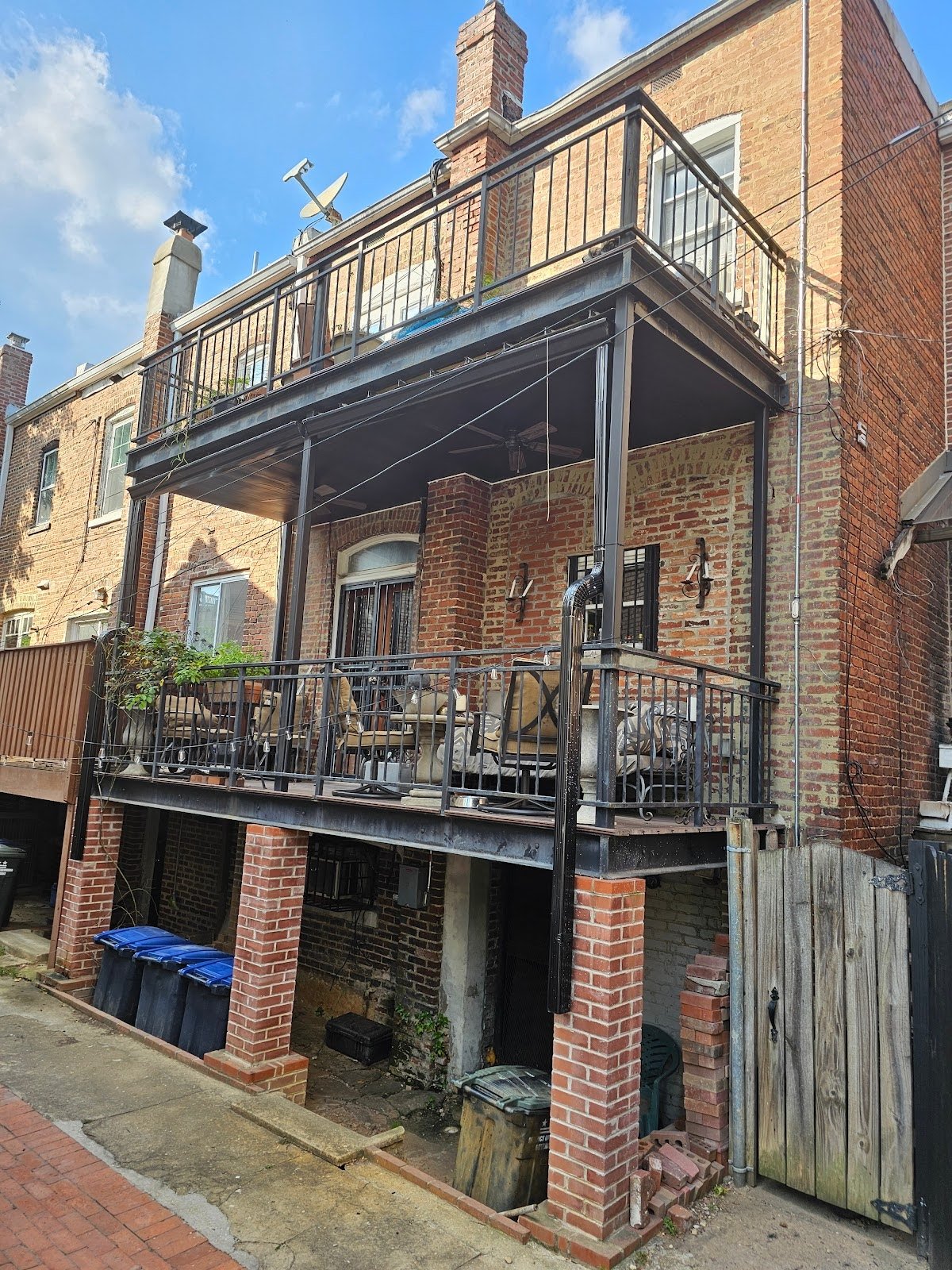
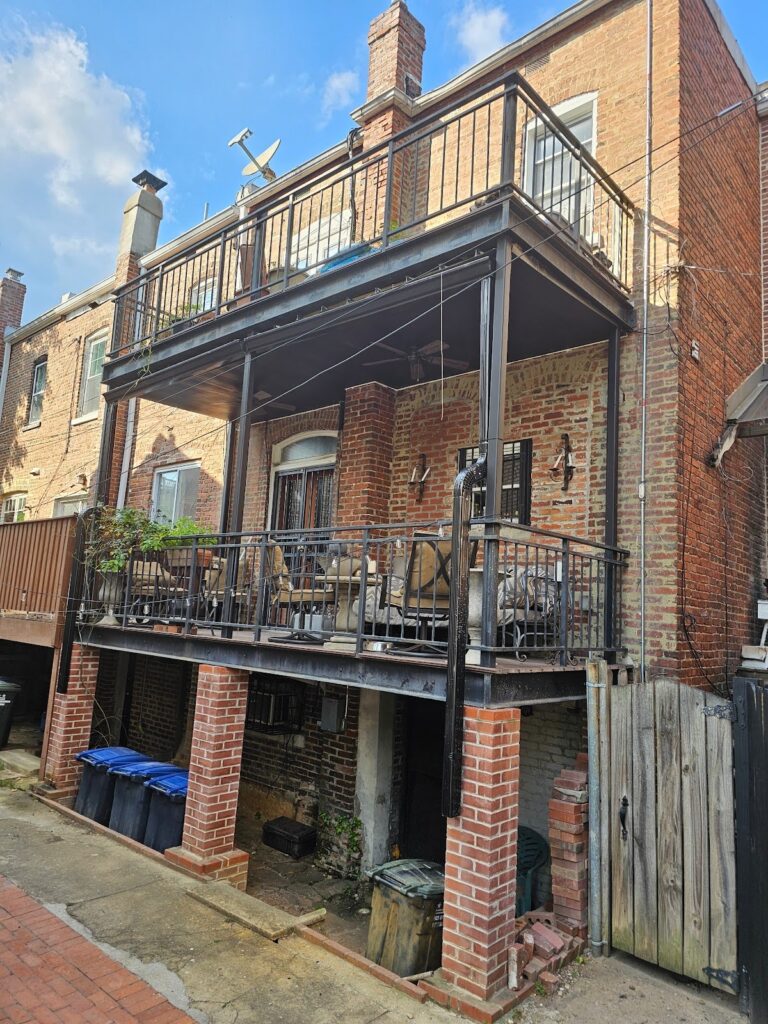
Here, it’s a walkway to the rear entrance, under deck at the basement level, It’s not specifically a parking area or access to a garage, but it’s still important. Where a car might not physically fit at all and therein need to have a deck made as thinly as possible, here it’s also important. Even though somebody could hunch over and walk towards the door in a crooked tight position to avoid hitting their head on the deck framing, that isn’t really a practical option.
For the basement to be finished and count as finished space You need to have at least 80 to 84 inches of clear space from floor to ceiling. Some of those provisions also apply to a rear area under a deck, as well.
The vast majority of basements, here in DC historic row homes, were unfinished at the time of original construction. In more recent decades, the price per square foot of every finished square foot in a DC home has increased so drastically that converting an unfinished basement to a finished living space has an incredibly high ROI. The same context of ROI applies with converting outdoor space into usable areas for seating and entertaining and even grilling and cooking.
It pays for itself and provides a lot of extra return to go the extra mile to make the floor to ceiling height large enough to meet the requirements of a finished space head height. It also pays for itself to improve exterior space by adding and or rebuilding exterior decks. Here, this is a two-story deck. One of the decks is situated just off of the kitchen at the rear of the main level of the house. The other upper deck is built off of the top floor rear bedroom. It’s really nice to be able to walk out from a bedroom to a balcony in the morning.
The vast majority of DC row homes are between about 15 feet to 19 feet wide. There are exceptions in both directions. There are cases where rowhomes are as thin as just 12 feet wide. There’s probably even some rare cases that are even thinner than that, but we at least know there are a handful that are just about 12 feet wide. It doesn’t leave a lot of interior space, but people manage to live inside of these thin rowhomes. (I did, for over 5 years.)
In the case of the 19 foot wide row homes, they are ample and more comfortable. There are some anomalies in the direction of exceptionally wide, as well. We’ve seen a handful that are 25 feet wide. There are even some that are built in double width.
One of the few downsides to the exceptionally wide row homes is that they need a continuous center bearing. In historic times they just had access to regular tree lumber. This is natural forest products without the modification and engineering of composite type technologies used today. At that time, the way the exceptionally wide row homes were built, they would need a center bearing point such as a load-bearing hallway wall that ran down the length of the row home from front to back in the middle area.
It wouldn’t necessarily have to be directly in the middle, but it would have to shorten the long span by at least about 6 ft. At that point, on top of the center bearing point, floor joists could be spliced and sister together. There are also examples of continuous floor joists that have up to 25+ ft lengths, but they are a bit rare and they’re generally thicker than a simple 2x dimensional size.
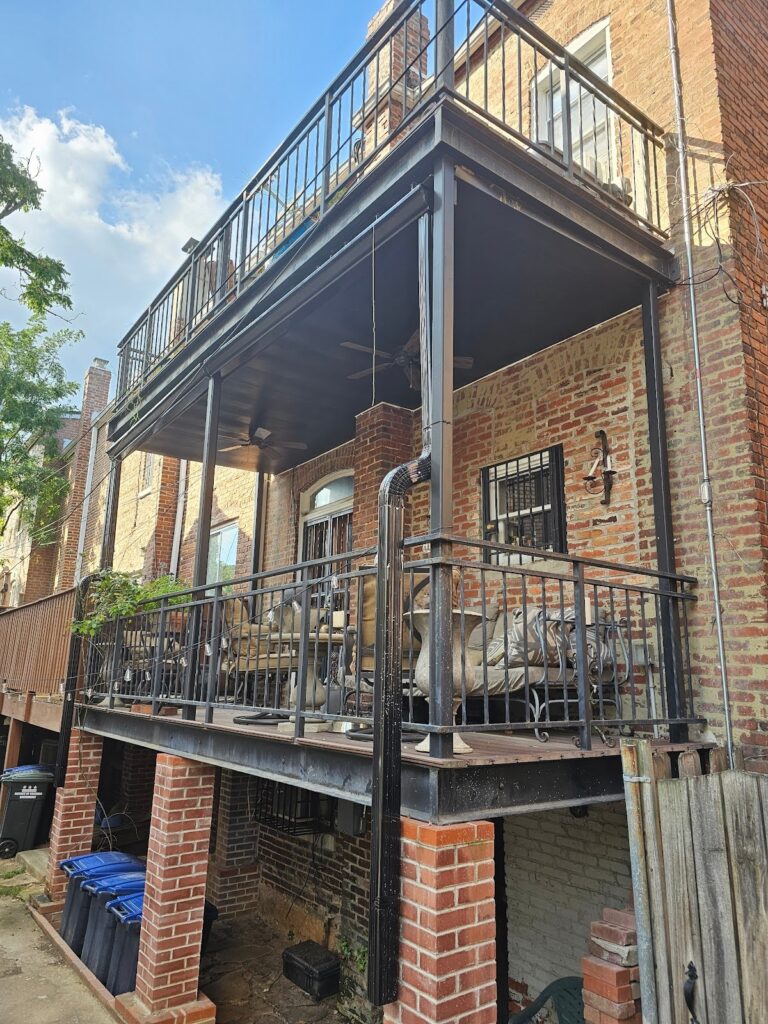
In this coming week’s blog article, we’re going to talk about some of the specific details and elements of the construction of this particular deck.
Use a contractor who understands and cares about doing things right. Always, feel free to reach out to us here at Dupont Decks and Patios. We are happy to help with almost all steps of the deck building and design process. A backyard and outdoor space should make a significant, positive impact on both quality of life and home value. We can help with more than just decks, we also build patios, pergolas, ramadas, awnings, gazebos, arbors, and privacy fences.
Let us know about your ideas and talk to us if you have questions about possibilities. We are happy to participate in improving your outdoor space and quality of life! You can call us at (202) 774-9128. You can find us online at https://dupontdeckspatiosdc.com and you can email us there as well at https://dupontdeckspatiosdc.com/contact-us