Today, we’re taking a look at a cobblestone paving area. Although this happens to be a a Paving area different than a typical walkway or patio, the design and construction is very similar. It’s really similar to a lot of the historic cobblestone paving used here in Washington DC. Most of the cobblestone paving in DC is made from granite stone. Granite stone is relatively easy to cut, but particularly difficult to break. It has a significant compressive strength.
Often, we are looking at and considering the compressive strength of historic brickwork. In the operation of historic brick restoration, the compressive strength is critical. By comparison to granite stone, historic brickwork has a very low compressive strength. Bricks are made from clay which isn’t that different from most types of mud that we are familiar with. This characteristic is very important to understand in repointing. Repointing requires the removal of the mortar at the outer planes of paving. That mortar is then replaced with newer mortar. We generally focus on using mortar which has strict compatibility with the substrate. Compatibility is related to using a mortar of both similar permeability and compressive strength. Historic bricks achieve their strength through a firing process which changes the clay of the brick from a relatively loose material to something more similar to a semi-vitreous material like some types of tile or glass. That semi-vitreousness fuses elements within the brick together. With historic bricks, they were generally fired at relatively low temperatures.
The compressive strength would reach to around 1,000 to about a bit less than 2000 pounds of resistance, per square inch. That means that the bricks are crushed or compromised or break when more than roughly 1,000 lb of pressure is applied, per square inch. It’s important to understand how this framework of analysis applies. A historic brick is roughly 8.5 inches wide x 3.5 to 4 inches wide. Those measurements apply to the surface area across the top of the brick when positioned in the stretcher configuration. These measurements amount to roughly 32 square inches of space. When 1,000 pounds per square inch is multiplied by 30, the total is is over 3,000 pounds. Just by simple extrapolation, you can basically assume that a typical historic brick can support roughly 10,000 to 30,000 pounds. The application of the force is important though. When the force is not applied completely evenly, the brick will I have a higher tendency too break. The difference is that in a point load or a concentrated point of pressure, the brick has a different type of force being applied, not just an overall load, which would put pressure in a compressive position, but in a pencil force. Small Point loads don’t just push downward on a brick, but also push the other parts of the brick outward which creates a tensile stress. Bricks are notoriously weak to resist tensile forces. These details are important for efforts in repointing. If bricks are repointed with modern mortar or mortar that’s not compatible, it will almost always, eventually, cause the bricks to fail.
For purposes of calculations, we generally expect granite stone to be around 15,000+ pounds per square inch of resistance. In some cases, we find that granite stone has much higher compressive strength. The compressive strength, on a macroscopic level, in other words visually apparent, is related to its microscopic structure. Like most types of stone, granite has a grain. We talk about grain more commonly when referring to wood. The grain of wood generally runs in the direction of its axial growth. Wood has significant strength perpendicular to its grain yet is relatively weak in line with the grain. Stone is very different in most ways, compared to wood, but it has this similarity.
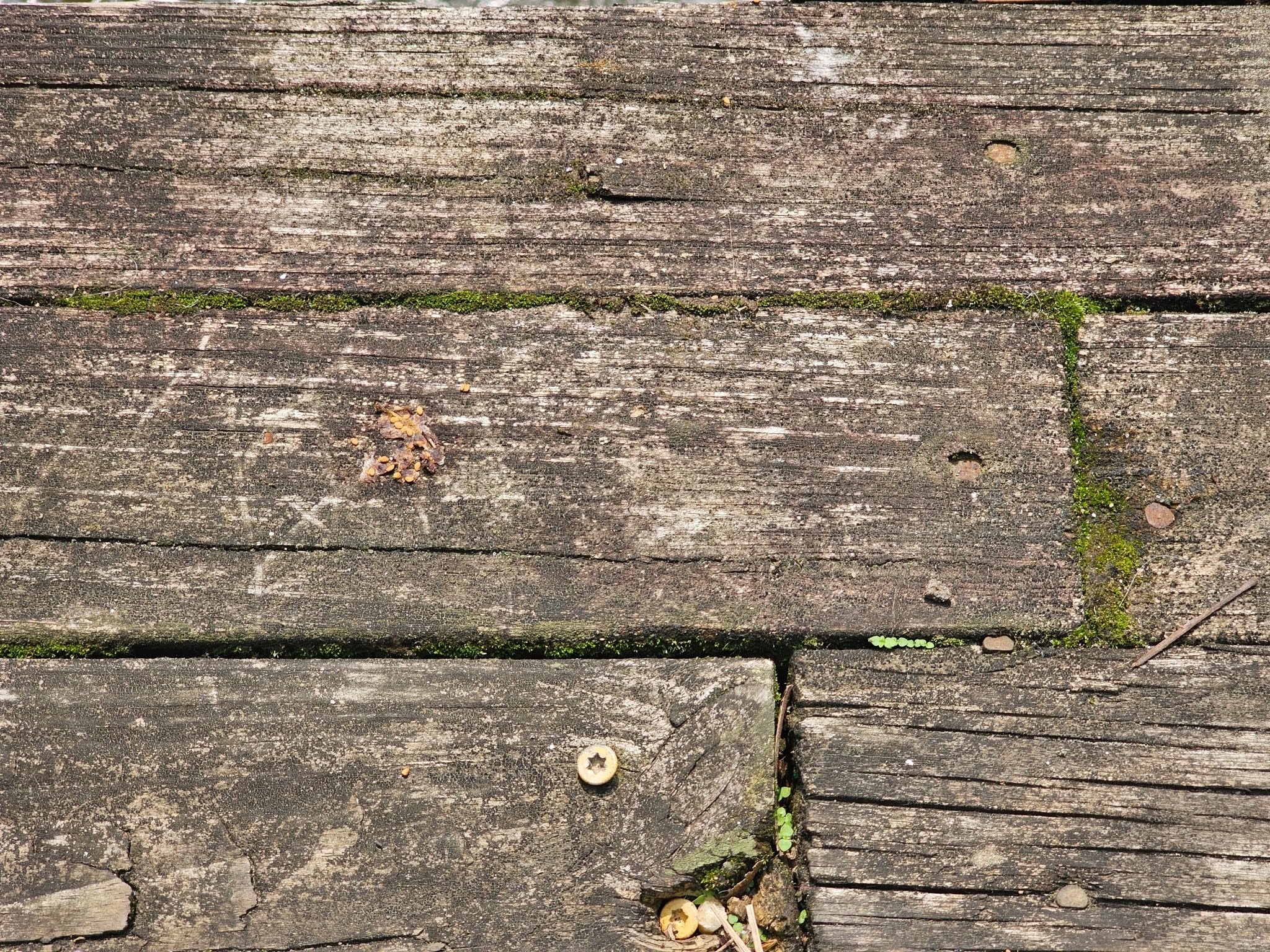
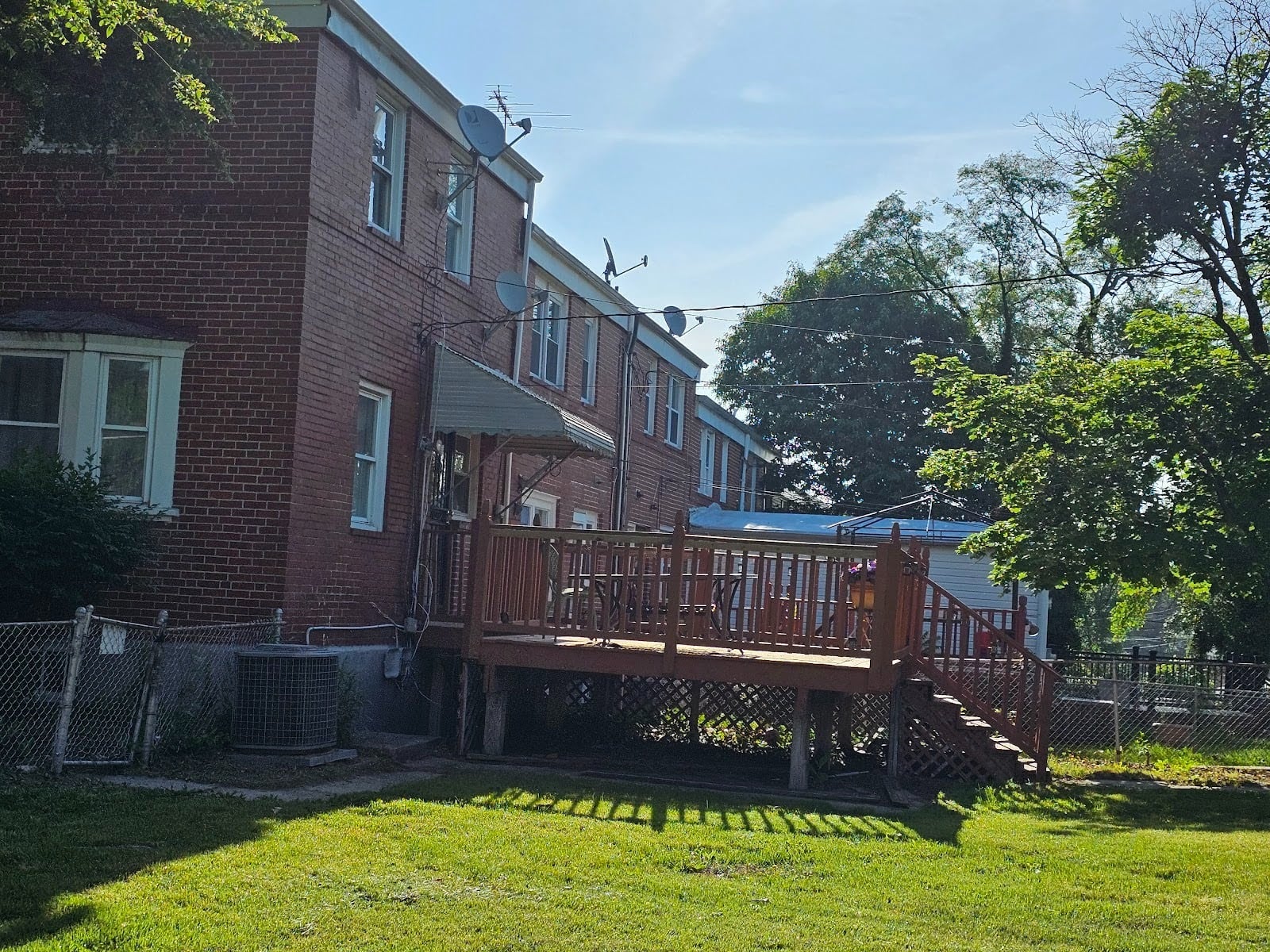
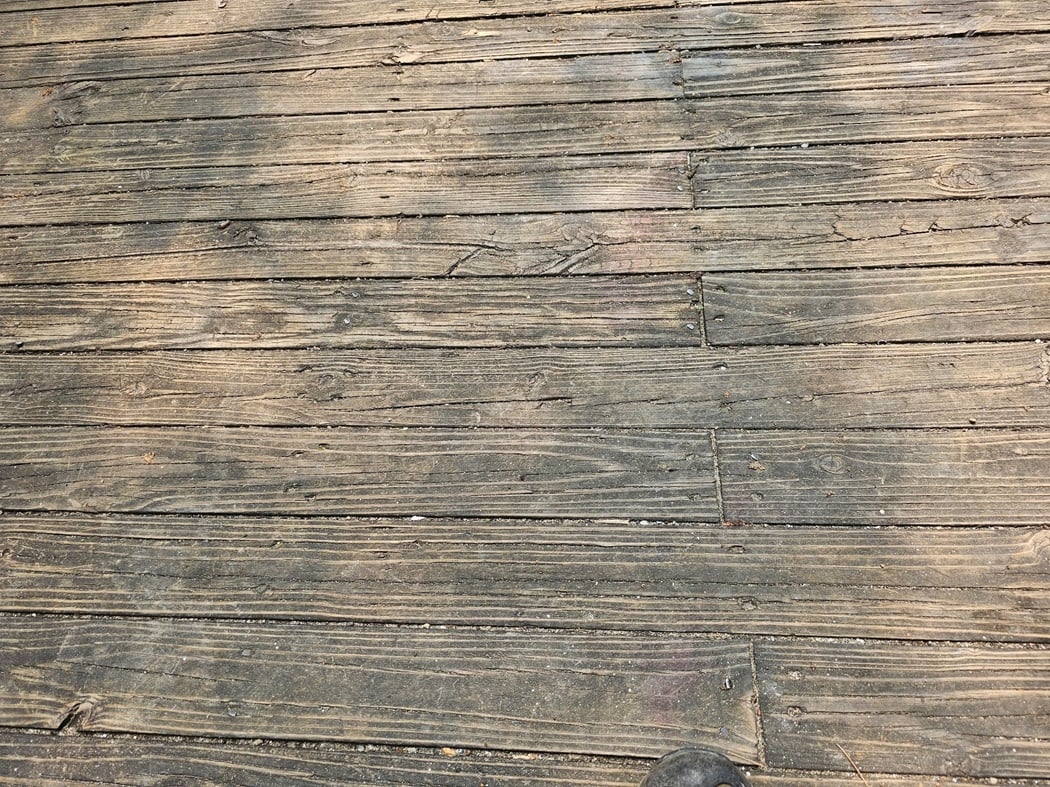
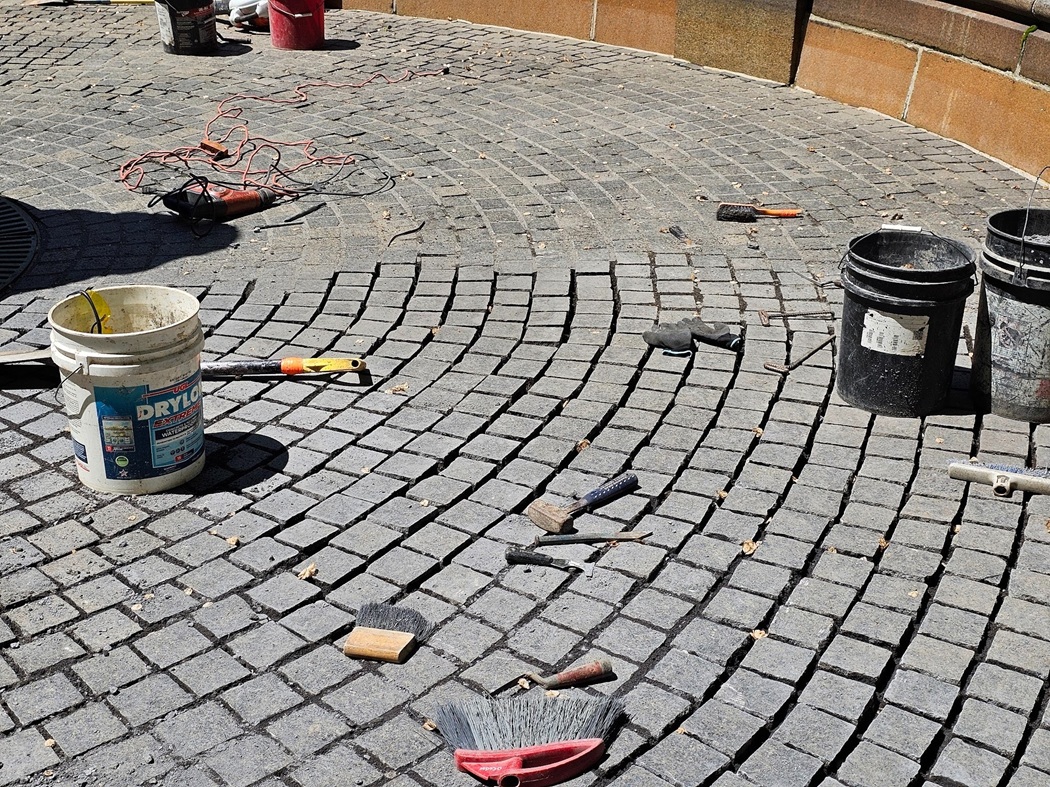
The picture below shows the area of repointing. Like a typical or patio, when properly maintained, this type of masonry paving can last for many decades. We often build decks and even platforms from wood. Wood softens the feel of a hardscaped area, but wood has limitations. Wood decks and paving areas are susceptible to moisture and break down at a comparatively faster rate. Like masonry, wood can also be maintained to provide care which will extend its life cycle significantly. When properly sealed and treated, wood decks can also last for many years. They aren’t even close to the predicted or expected lifespan of a granite stone paving area though.
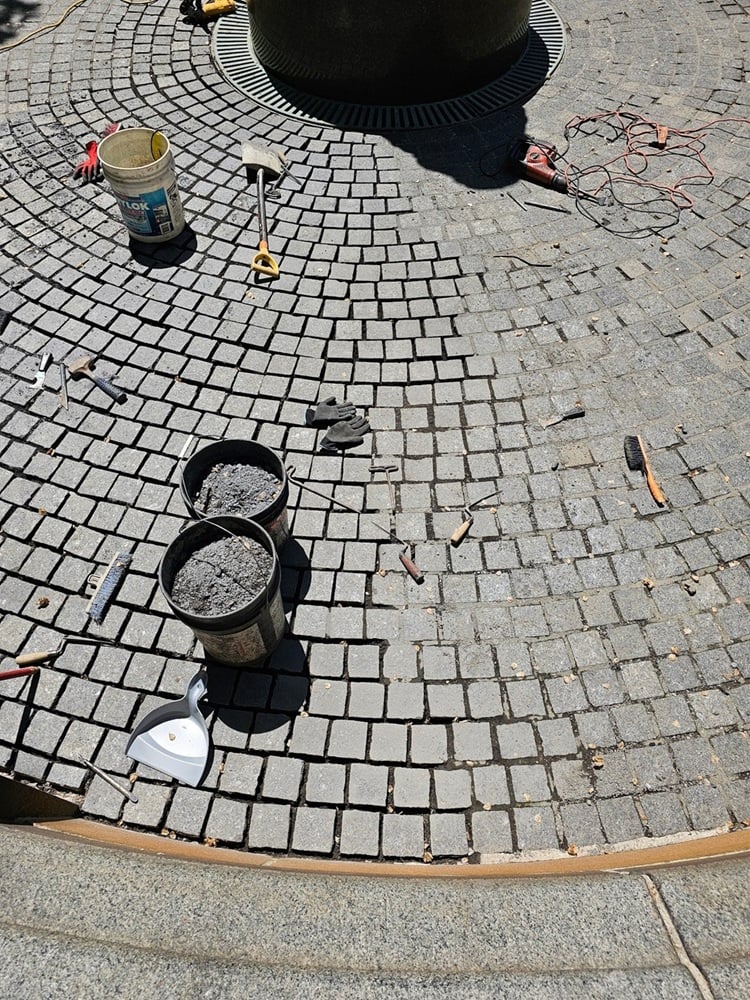
In the picture below, we showed some of the raking tools used to remove the deteriorated old mortar. Even though it’s become soft or more fragile through deterioration, it can still be extremely laborious to remove. Basically, when mortar is cured, you can think of it a little bit like a rock. Some rocks, like granite stones are tougher than others but cured mortar isn’t easy to break apart. Even after it’s been deteriorated for decades, parts of it, beyond the surface, might require significant force to remove. Generally, when it is significantly deteriorated, the outer surface is weaker as you go farther in, it gets harder.
In this coming week, we’re going to talk more about the tools used in masonry restoration, particularly focusing on the tools used to remove old and deteriorated mortar. This type of topic might not be important to most deck and patio contracting companies; however, we are a bit different. Unlike companies who focus just on the sprawling suburbs, our company is based and focused on both the historic areas of Washington DC and the surrounding more modern areas.
Use a contractor who understands and cares about doing things right. Always, feel free to reach out to us here at Dupont Decks and Patios. We are happy to help with almost all steps of the deck building and design process. A backyard and outdoor space should make a significant, positive impact on both quality of life and home value. We can help with more than just decks, we also build patios, pergolas, ramadas, awnings, gazebos, arbors, and privacy fences.
Let us know about your ideas and talk to us if you have questions about possibilities. We are happy to participate in improving your outdoor space and quality of life! You can call us at (202) 774-9128. You can find us online and you can email us there using contact form there.