This past week we looked at an area that is paved with ashlar cobblestone. Unlike typical cobblestone which is rubble and formed or shaped to a degree but still a bit rough and inconsistent, from one to the next, this particular type of granite paving has been cut on five or six sides. Each masonry unit essentially has six sides. We think of square shapes as having four sides but there’s also a top in the bottom so six sides in total.
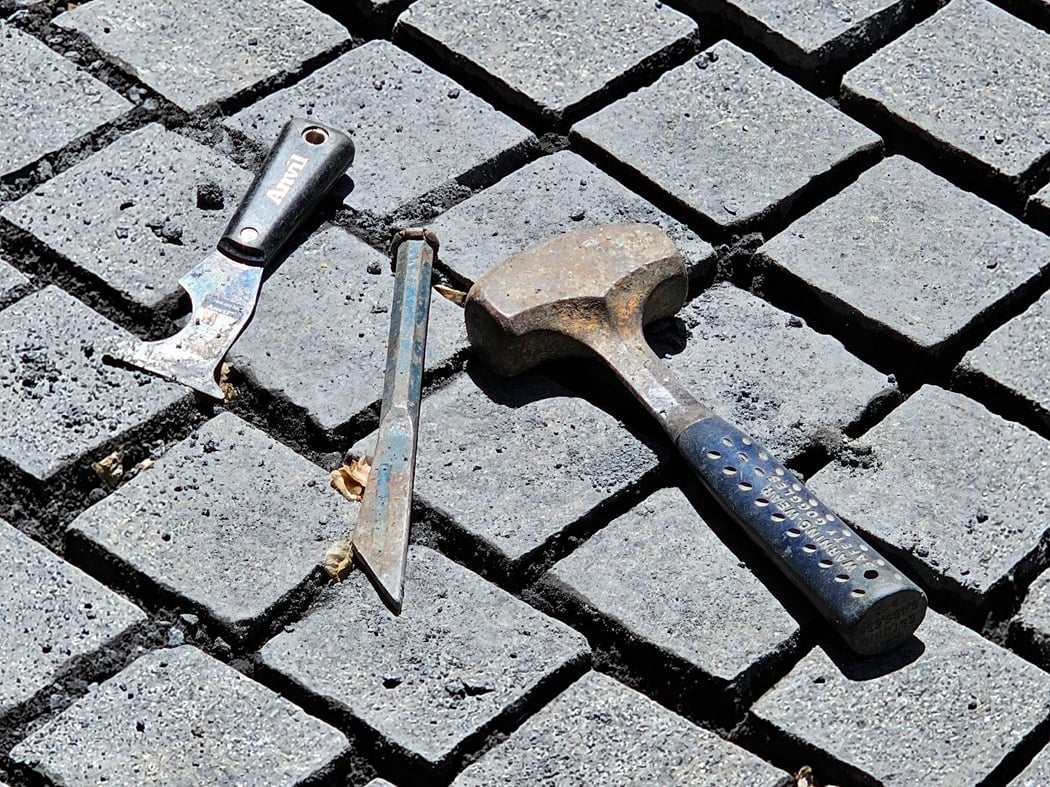
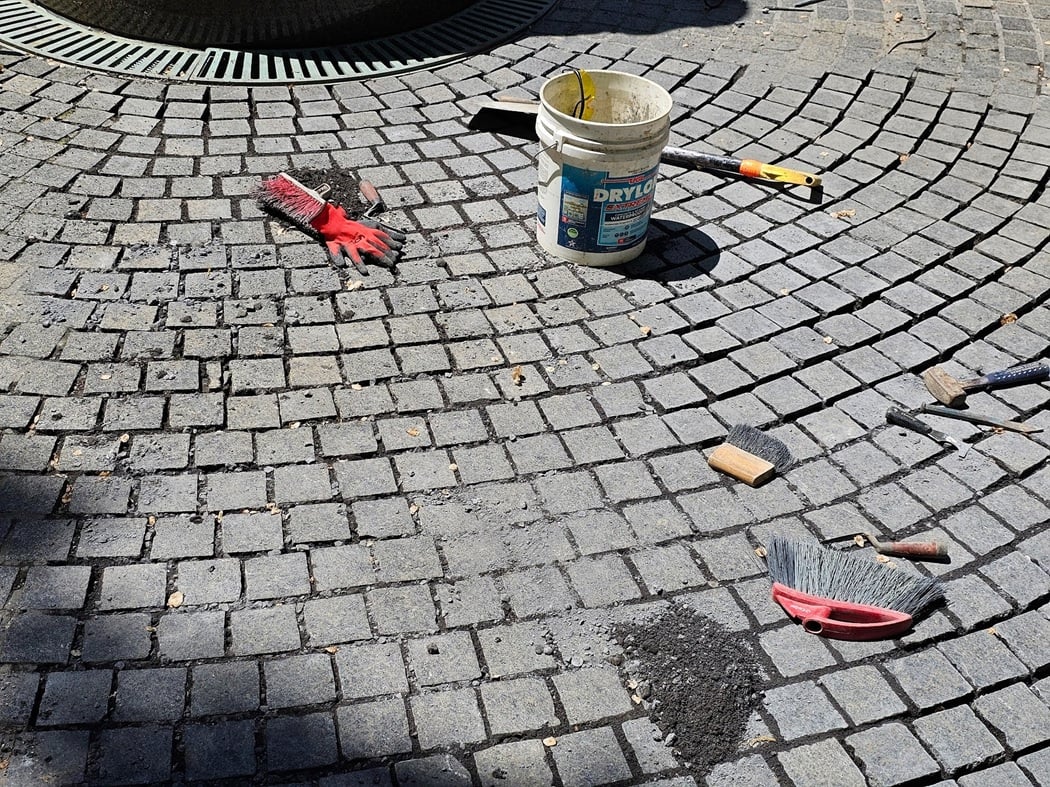
Today we’re looking at this same area that we looked at this past week, but today we’re focusing on the tools. We talked about the restoration process of removing the old mortar and replacing it with a newer mortar. We will mention again that it’s extremely important that the newer mortar has similar characteristics of compatibility. The mortar itself has to have a compressive strength and a level of permeability similar to the remaining existing mortar. These elements are very important for historic brick masonry. If the compressive strength or permeability are calibrated incorrectly, it can lead to destruction of the bricks. When brick units are broken or destroyed from incompatible mortar, it can destroy the entire facade or paving. Here though, at the stage of work shown in the picture below, they’re just in the middle of the removal process. That process comes before installation of the new mortar, particularly in paving areas. In wall repointing, portions of the wall may be removed and refilled with new mortar, in the repointing process, before additional adjacent areas have the mortar removed. In other words, in wall restoration, the work might happen in incremental small steps, area by area. In horizontal paving areas though it’s more common for larger areas to be repointed in larger sections.
Three common tools are shown in the next picture below. We will start from the left side and work to the right. First, you can see on the left side of the tools, there is a putty knife. That putty knife can be used for multiple different types of uses, but by and large, the most common use here is to scrape things off of the masonry units. It’s good to grab a hold of loose pieces that have already been broken out and grab the small remnants left behind. This type of tool doesn’t have a high level of resistance though and it can’t be used with limited levels of pressure. It’s just a relatively thin piece of metal.
The next tool shown is a plug chisel. Plug chisels are similar to other masonry chisels, but they have a long section at the point where there is no taper. Instead, the shaft of the chisel remains straight. The alternative edge has a taper but by not being tapered on the thin edge, it allows the chisel to reach deep into mortar spaces without pressing against the sides. If the chisel did not have this thin shaft without a taper, when forcing it directly between masonry units such as bricks, it would break the edges of the bricks. Here though instead, it can be forced directly against the mortar without pressing against the brick edges.
Tools have a tendency to wear down over time, but plug chisels and hammers are made from durable steel that is tempered at the faces of the work surfaces. The entirety of the steel is not tempered, if it were tempered the entirety of the steel would actually become a little more brittle. Temper steel has a much higher resistance to deformity, but it has a higher tendency to shatter when struck by other tempered metal objects. This specifically applies if the other metal objects have tempered faces. In the case of the hammer, the head of the hammer has a tempered face at the areas of impact, at the edges of the head of the hammer. The shaft and handle of the hammer on the other hand are likely not tempered to the same degree.
In the coming week we’ll take a look at the mortar raking tools. These are the tools used to scrape out the old and deteriorated mortar from the joints. Just to clarify though, even though the mortar is referred to as deteriorated, it doesn’t mean that it’s not hard. Sometimes it’s still very difficult to remove it.
Use a contractor who understands and cares about doing things right. Always, feel free to reach out to us here at Dupont Decks and Patios. We are happy to help with almost all steps of the deck building and design process. A backyard and outdoor space should make a significant, positive impact on both quality of life and home value. We can help with more than just decks, we also build patios, pergolas, ramadas, awnings, gazebos, arbors, and privacy fences.
Let us know about your ideas and talk to us if you have questions about possibilities. We are happy to participate in improving your outdoor space and quality of life! You can call us at (202) 774-9128. Learn more about our services, and feel free to contact us through our online contact form.