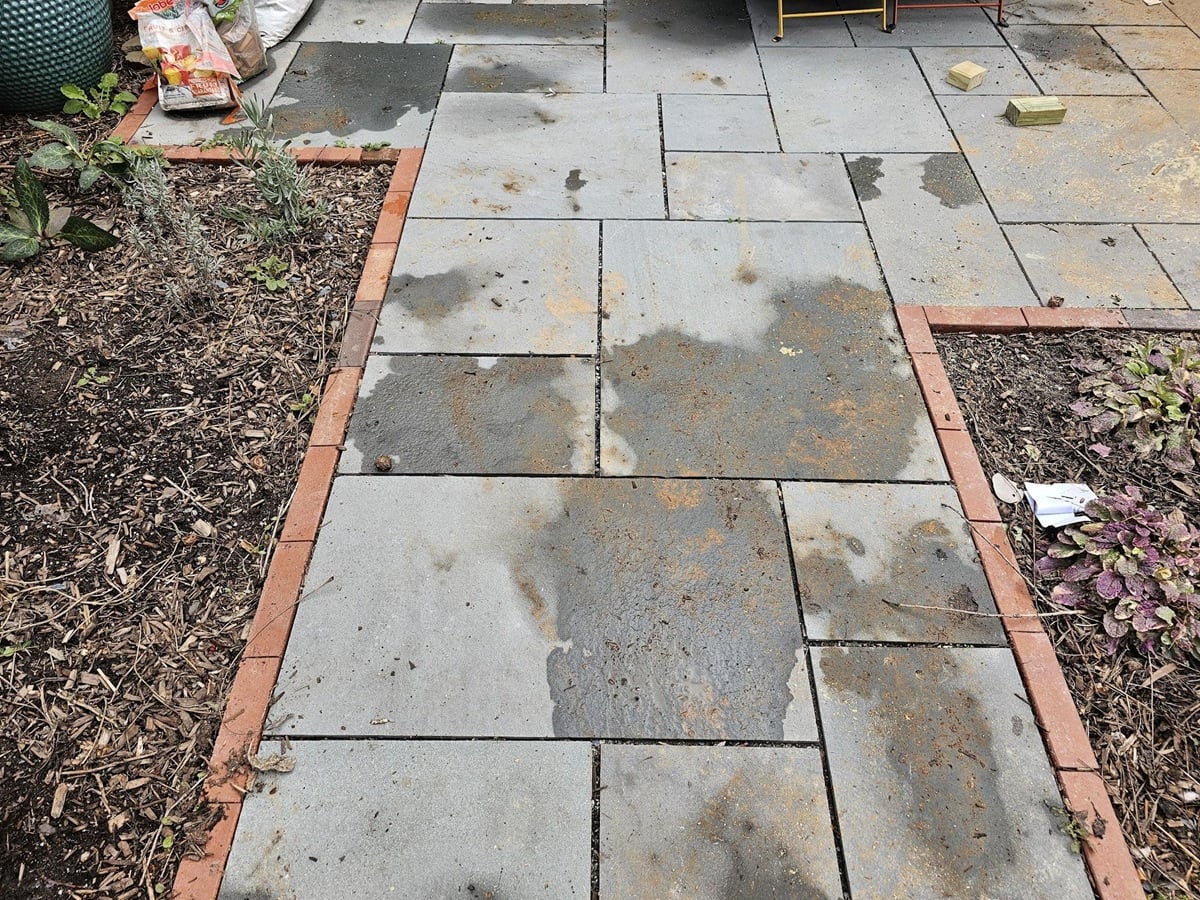
This past week we looked at a brick walkway with a raised vertical brick edging. Today we’re looking at something that’s kind of similar but really just for aesthetics. The walkway that we looked at this past week had both brick paving with a brick edging so there was a little bit of visual continuity. Here, in contrast, there’s an intentional visual distinction, which allows the brick edging to create a visual differentiation.
Yet the different elements of masonry complement each other and the brick perimeter edging also visually ties the adjacent elements of the hardscape and the building together. Without it, the walkway looks a bit distinct in a way that kind of makes these slate feel foreign to the other architectural elements of the site.
At a glance, you might notice one of the positive characteristics of the raised edging that is lost by having an edging at the same plane as the remainder of the walkway. At the edging we looked at this past week, there were adjacent mulched garden beds on both sides of the walkway. Here as well, there are mulched garden beds on the sides of the walkway. In fact, here, the mulching itself is not as deep as the mulching which we looked at last week. In fact in this particular case it would be hard to mulch very deeply up to the edge of the walkway because that mulch would pour over into the walkway.
Even without a deep bed of mulch, you can see that the mulch is already spilling onto the edges and into the area of the walkway. From a maintenance perspective this type of installation is more problematic. Without being able to apply a deep bed of mulch, you end up getting a lot more weeds into the garden area and more spilling over. Without even having a deep bed of mulch with the mulch is constantly spilling into the area of the walkway. Keeping it clean requires extra effort.
There’s a few different options for elements that can be added to the perimeter installation of a paving area like the one shown in this example here today. One of those elements is to create a mortared cement shoe that is hidden underneath of the ground into the area of the landscaped planting bed. Essentially, at the bottom of the outer edge of the walkway, the masonry elements of the paving can have an application of mortar or concrete applied so that they’re bounded in place. Flexible but strong plastic edging can also be added at the perimeter.
In most types of applications like that, you can still visually see the upper edge of the plastic border. It doesn’t necessarily look terrible because it’s relatively thin, yet here in this case the binding outer shoe is completely visually hidden.
In many cases like this a concrete substrate area is built on to the subgrade after extreme compaction. That helps the paving area resist movement from forces applied from underground. In many cases will be nearby trees with roots that reach far out from the tree trunk itself. Eventually, as years go by, those roots might start applying concentrations of pressure up from underground that lift up the walkways. We see this all the time and the historic neighbors of Washington DC. There will be sections of the concrete sidewalk that are lifted several inches above the intended planar surface area.
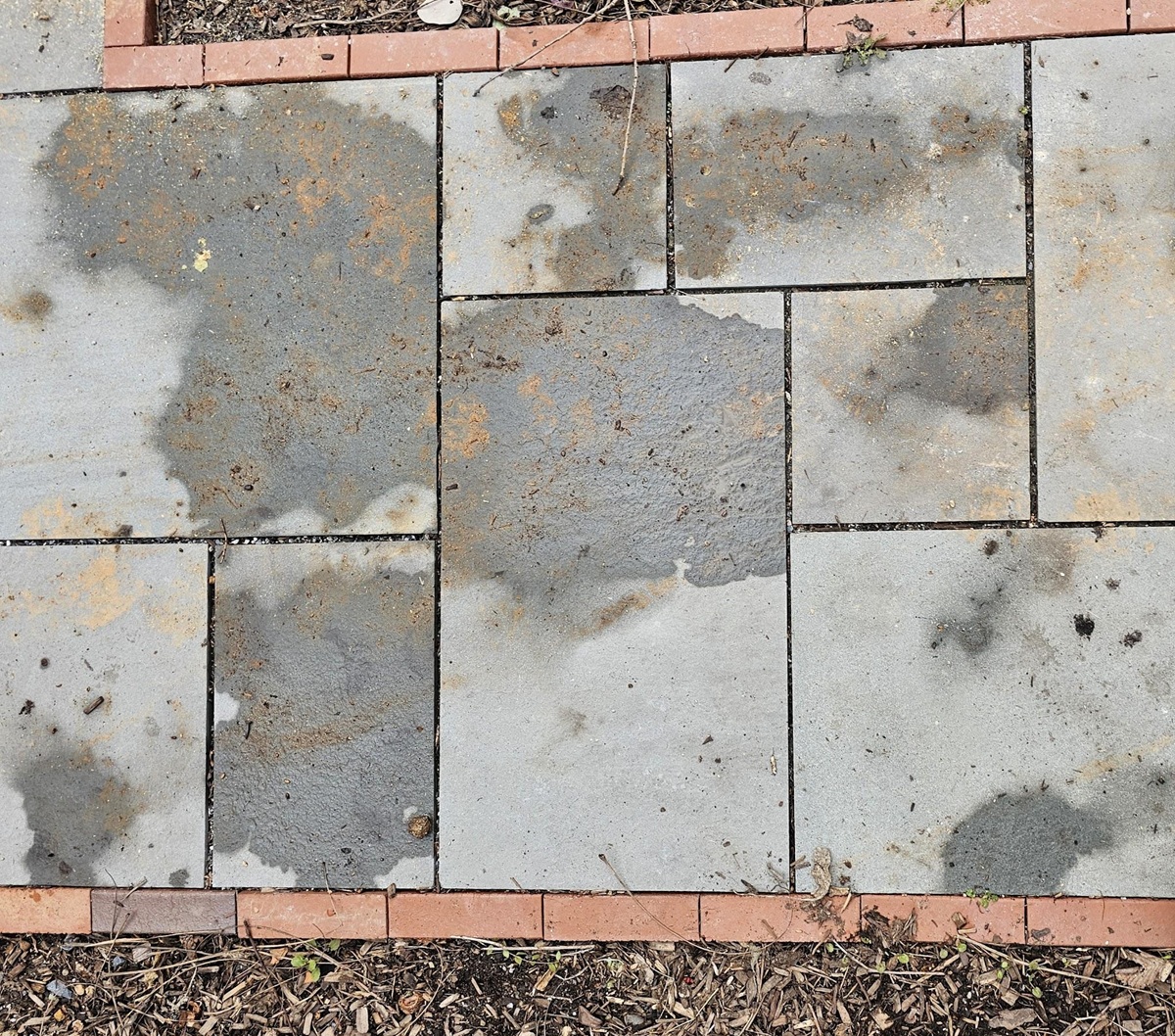
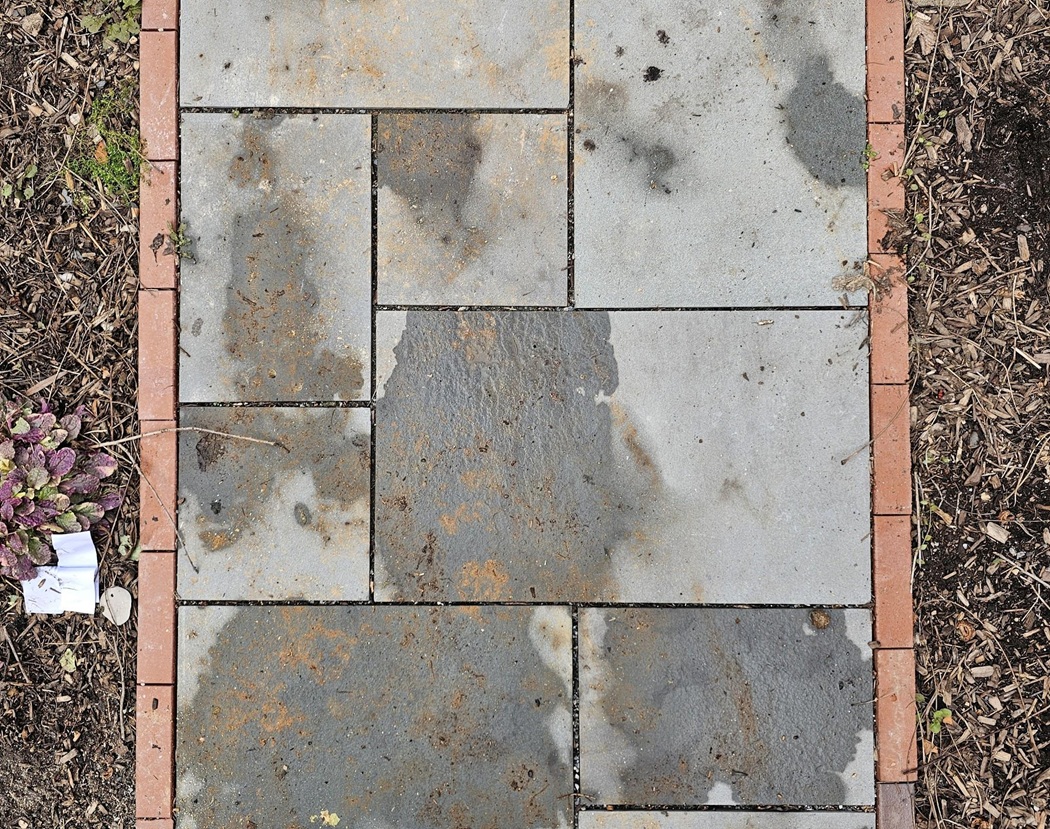
The particular stone here is an ashlar cut natural Potomac Bluestone with a surface cleft that almost follows its natural plies. The upper surface itself could be grinded and cut to be near perfectly smooth. Instead the near natural cleft facing is left basically as it would be found in the wild with slate variation that follows the natural veining of the plates of the mass stone. You can see there are elements of both the blue color and a bit of a reddish earthtone highlight color.
This type of stone, to a degree, may have elements or concentrated areas of natural rust stains caused by iron oxidation.
The bluestone was formed through extremely high levels of deeply buried compression of rock, millions of years ago. In a deeply buried area below the surface of the earth, there was a lack of readily available oxygen which led to this deep blue or gunmetal type of color.
We recommend building and homeowners here in Washington DC use a contractor, like us, who understands and cares about quality, deck and patio longevity, and simply doing things right. Always, feel free to reach out to us here at Dupont Decks and Patios, you can give us a can or just drop us a line.
We are happy to help with almost all steps of the deck and patio building and design process. Let us know about your ideas and talk to us if you have questions about possibilities. You can call us at (202) 774-9128. You can find us online and you can email us there as well at https://dupontdeckspatiosdc.com/contact-us/