Rear Row Home Low Deck Design and Installation Ideas
For typical historic row homes, particularly here in Washington DC, there are a few different types of common layouts for decks. One of the most common deck layouts is the rear deck built off the ground level rear that leads to a kitchen. In the most common variety of that layout there will be almost an entire level of head height at the rear of the building below the deck. In some cases, it works out perfectly because a car can be parked directly under that deck. In some cases there will even be a garage and a driveway underneath the deck.
In most cases like that, the driveway will pass under the deck and then open up to a garage door which is seated in the building’s rear basement opening. In those cases the garage door will be in line with the remainder of the rear wall above.
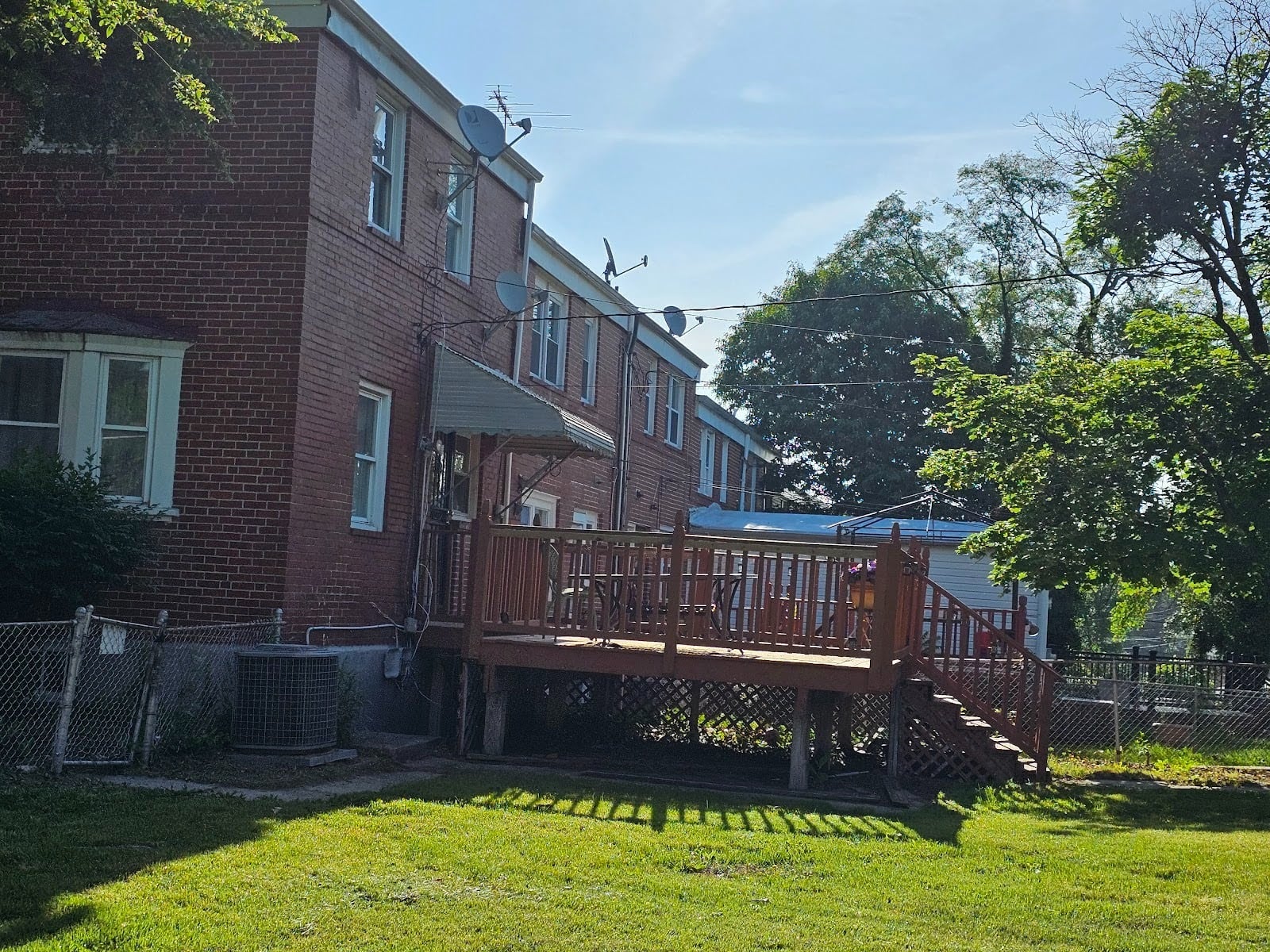
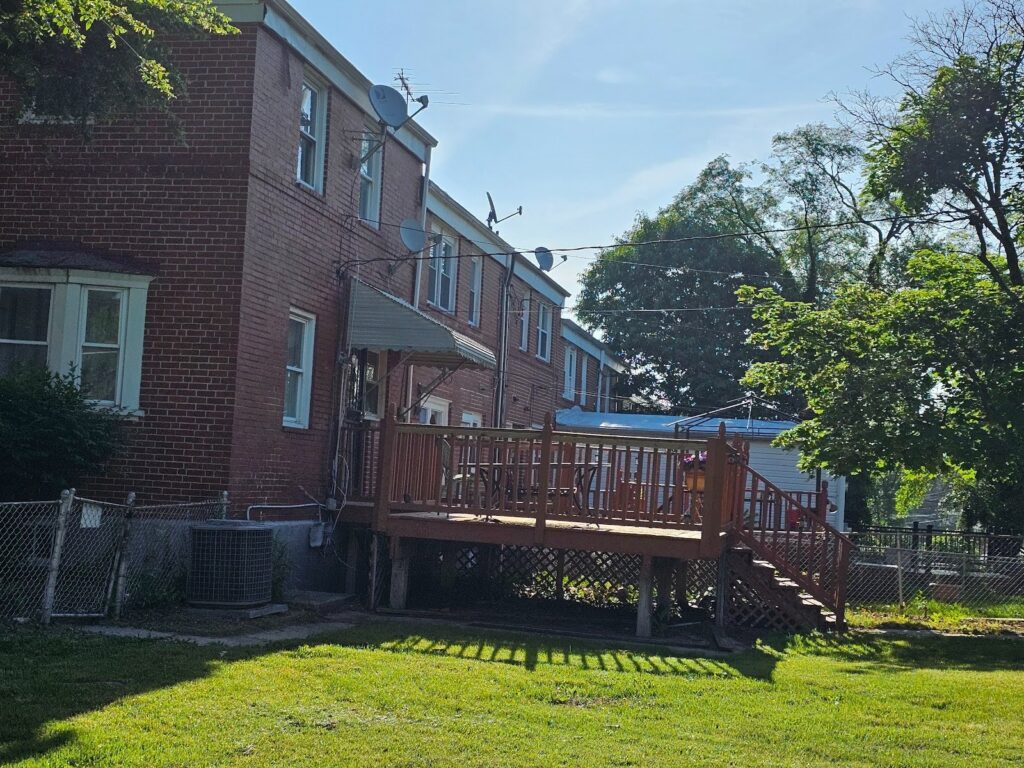
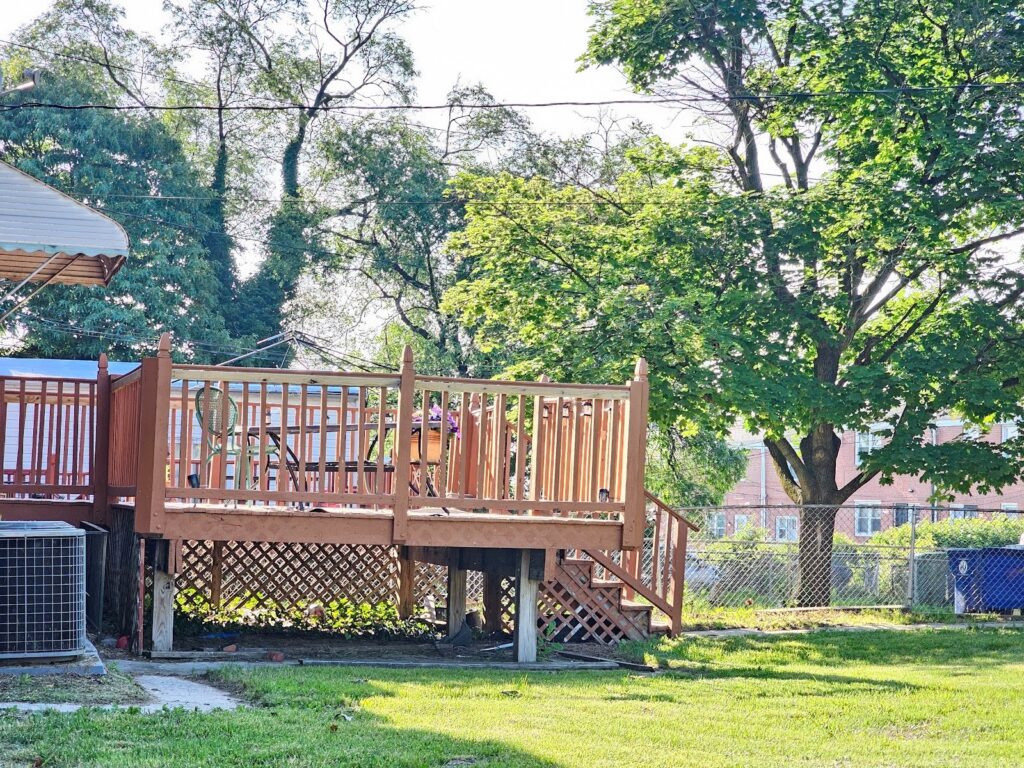
We’re looking at a different type of layout today though. Instead, this one is built with the deck much closer to the ground. If you look closely in the picture below, you can see that there are six risers in the assembly of the stairway from the ground level to the rear deck. Generally, the vertex will be set just about an inch below the threshold into the door that leads to the rear of the building. In total, with six risers, there might be a total elevation difference of roughly 42 inches.
If each riser is roughly seven inches tall, then in this case, there would be six risers times seven inches tall and that would equal 42 inches in total height difference between the height of the walking surface of the deck and the ground level below. You can look at this small stairway from a distance and see that they have included a complete balustrade system on both sides of the stairway. That is required when the difference in elevation between the deck and the adjacent ground is over 30 inches, in most cases.
Most of the other elements of the deck look relatively simple and common or typical. The loan path of the deck substrate is built with posts that are 6 inch x 6 inch pressure treated southern yellow pine. That’s a common type of material and post thickness for low decks. We generally recommend 6×6 posts because they have a much higher structural capacity than the next most common alternative of 4×4 posts. The difference in thickness applies particularly when the post tops are notched to shoulder and connect to the deck girders and joists. If you have a double joist girder, for example, it requires a three inch cut into a post.
If the post is only 3.5 inches thick, in the case of a 4×4 post, it won’t be able to carry the girder if there’s only one half of an inch of wood thickness left after notching. Generally, in a shoulder-type connection, the wood will seat on top of the post, but the post must extend vertically alongside the vertical side of the girder. Bolts will be driven through the side of the post and through the side of the girder. A half of an inch of wood is not significant enough to support the bolting of a deck girder.
A rear deck can be set at a wide range of heights and can be made to work. Generally there’s a lot of flexibility because these elements are mostly all custom built. We particularly like a deck that’s more than about 30 inches above grade though because otherwise it can be very difficult to work at the underside of the deck. Instead of having an open space, like a comfortable clear space, a deck of 30 inches or less can be so tight that you cannot access the space under the deck without literally having to crawl through.
That’s uncomfortable and makes it difficult both from and upkeep and maintenance perspective and also eliminates the ability to practically use the space for storage.
Here, even though the space of the deck is uncluttered, they have installed a lattice as a skirting at the stairway portion and the far side area of the deck. With a lattice skirting it makes stored items a little bit less of an eyesore or an area of unsightly mess.
Use a contractor who understands and cares about doing things right. Always, feel free to reach out to us here at Dupont Decks and Patios. We are happy to help with almost all steps of the deck building and design process. A backyard and outdoor space should make a significant, positive impact on both quality of life and home value. We can help with more than just decks, we also build patios, pergolas, ramadas, awnings, gazebos, arbors, and privacy fences.
Let us know about your ideas and talk to us if you have questions about possibilities. We are happy to participate in improving your outdoor space and quality of life! You can call us at (202) 774-9128. You can learn more about our services online at Dupont Decks and Patios DC through our website, and you can also reach us directly by visiting our contact page for inquiries and project details.