Often, here on our website, we show a handful of different things that can be done to make decks better. Today we’re looking at actual defects and problems in installation of other’s deck construction. The first thing we’re looking at is a ledger board.
LEDGER BOARDS
In several blogs, here on our website, in the past, we’ve looked at the ledger boards in deck construction. The ledger board is very similar to the rim joist at the side and the front leading edge of the deck. However, the ledger board, instead, is at the base of the deck, where the deck attaches to the rear wall of a building. Not all decks are installed at the rear buildings and it doesn’t necessarily have to be where it attaches to the rear wall, but generally where a deck attaches to the exterior wall of a house, the board that connects the deck to the building or house is the ledger board. That ledger board doesn’t need to be supported by posts below, it’s attachment to the building wall is enough to support it, when built correctly. In most cases, building exterior walls are of structural capacity and load bearing. If it’s a framed building wall, the deck can be bolted on, in most cases, directly to the studs or the existing internal rim joist. If the building is a masonry building as is so common here in Washington, DC, the bolts of the deck ledger board can be anchored directly into the masonry facade.
Not all masonry facades are of load-bearing capacity, but in historic buildings here in Washington DC, most are. One of the particular concerns about historic masonry walls in Washington, DC though is that many of the brick facades are built with historic brick. For a bolt attachment though other types of structural resistance such as tensile and pull-out resistance is very important. Historic bricks do not have the same capacity in these terms compared to modern bricks. As an alternative to wedge anchoring or the lag bolting in some cases all-thread can be used and then secured with a structural plate and a nut and washer. That type of connection generally has a significant amount of resistance, especially if it’s also in combination with a rim joist of the interior floor framing system.
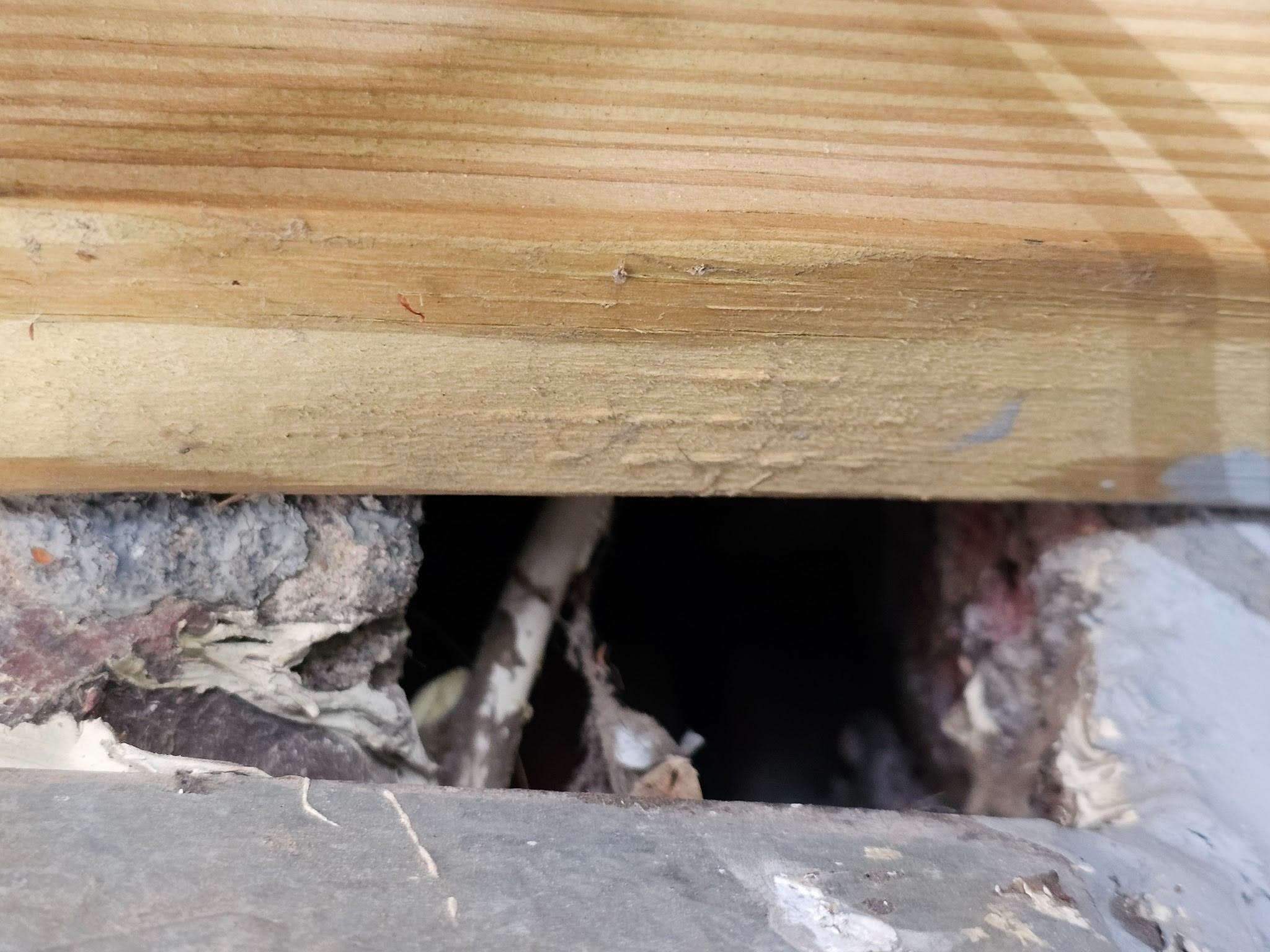
Specifically, in the picture below, you can see a particular defect. The substrate masonry has voids and openings in the historic brick wall where the ledger board is attached. This particular picture was taken from a low angle looking upwards towards the underside of the ledger board. About a hundred years ago, at the time of the original construction of the historic building, there were often old sleeping porches attached to the back of these historic row homes. In many cases, those sleeping porches were nailed onto the face of the building. Openings were left in the brick so that wood could be inserted as the other boards. Those wood pieces were set into the brickwork as it was built, course by course, going upwards. Today though, many of those original wood nailer boards have rotted out completely or been removed.
FOOTER PLATES
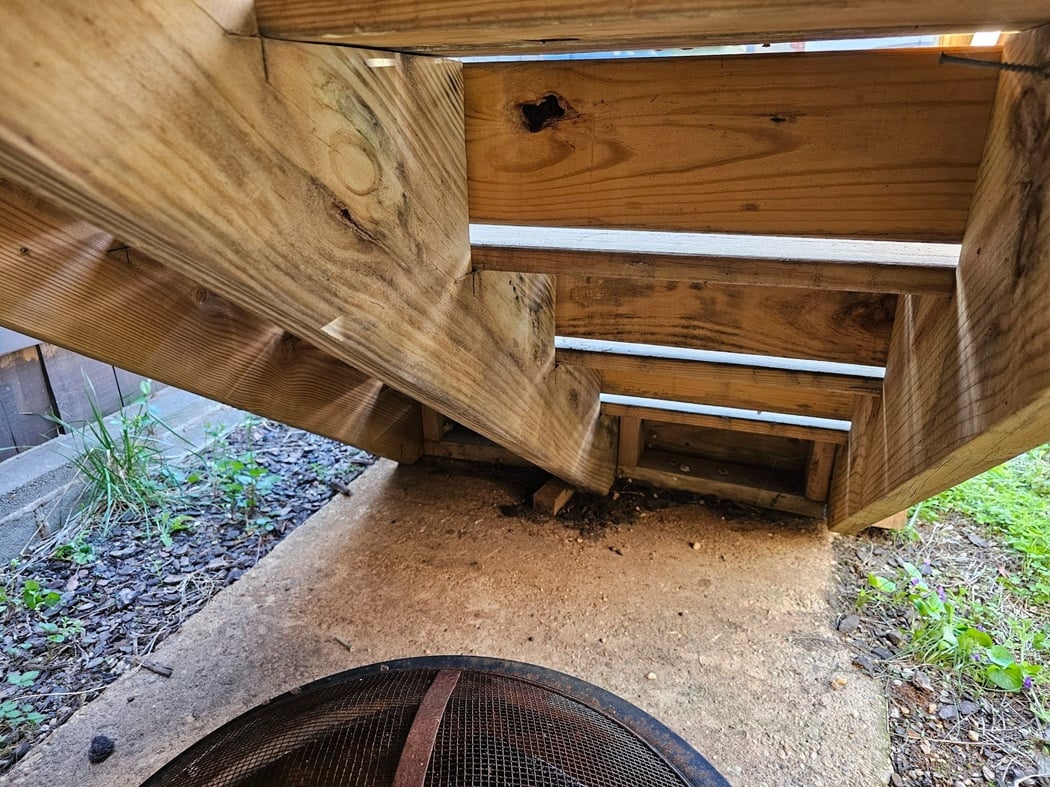
In most cases, depending on the exact configuration or layout of the stairway, the stair will be connected to a rim joist at the edge or perimeter of the deck. That connection will basically hold the deck stair in place at the upper edge, but it also should have a connection at the lower edge. Without it, when heavy weight is applied to the stairway the deck and stairway can pull downward slightly and the angle of the stair will change. That movement is enough to weaken the upper joint over time. Instead, though, by using a footer plate at the base of the stairway, the base of the stairway can be firmly connected to the substrate. In most cases substrate will be either footings set into a landscaped area or the base plate can be set directly to a concrete or asphalt or masonry paving area. Often a bird’s mouth (like a rabbet joint) notch will be cut out of the bottom of the stairway stringer to fit with a notch cut out of the stringers. This will allow the footer base to lock directly into place with the stair stringers.
Use a contractor who understands and cares about doing things right. Always, feel free to reach out to us here at Dupont Decks and Patios. We are happy to help with almost all steps of the deck building and design process. A backyard and outdoor space should make a significant, positive impact on both quality of life and home value. We can help with more than just decks, we also build patios, pergolas, ramadas, awnings, gazebos, arbors, and privacy fences.
Let us know about your ideas and talk to us if you have questions about possibilities. We are happy to participate in improving your outdoor space and quality of life! You can call us at (202) 774-9128. Visit our website to learn more about our deck and patio services, or send us a message through our convenient online contact form.